
Cousinia postiana
Cousinia postiana
Description
Growing requirements
Cousinia postiana is a perennial herbaceous plant belonging to the Asteraceae family. It is a specialized species native to the arid mountainous regions of the Middle East, particularly within the Syrian botanical zone.
The plant thrives in rocky, well-drained soils where mineral content is relatively high. It is highly intolerant of waterlogging, as its root system is adapted exclusively to xeric environments with rapid water percolation.
Regarding climate, Cousinia postiana requires intense solar exposure and high diurnal temperature fluctuations to complete its life cycle. It is categorized as a xerophyte, showing remarkable resilience to prolonged drought periods.
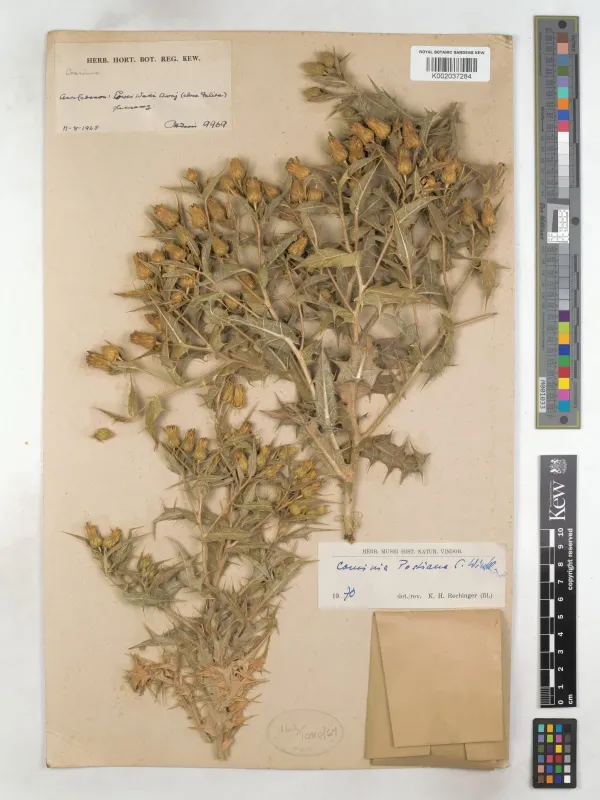
Botanically, the plant is characterized by its rigid, spine-tipped leaves and robust stems. These morphological traits serve to prevent transpiration and provide a chemical and physical defense against herbivores.
While not a commercial crop in the traditional sense, it is studied for its genetic potential in desert agriculture. Its ability to extract nutrients from poor, rocky soils makes it an object of interest for conservation biologists.
Main diseases and pests
The primary threat to Cousinia postiana populations is habitat loss driven by human activity, including overgrazing by domestic livestock in mountainous areas.
Fungal pathogens represent a significant risk when the plant is grown in artificial conditions with high humidity levels, leading to crown rot and root decay.
Insects, particularly those that target floral tissues, can drastically reduce seed production, which limits the natural recovery rate of established populations.
Soil erosion and the compaction of mountain terrains threaten the stability of the plant's native ecological niche, making re-establishment difficult.
Monitoring disease and pest presence is crucial for wild populations, as limited genetic diversity within isolated pockets can make the species vulnerable to rapid outbreaks.