
Climacoptera brachiata
Climacoptera brachiata
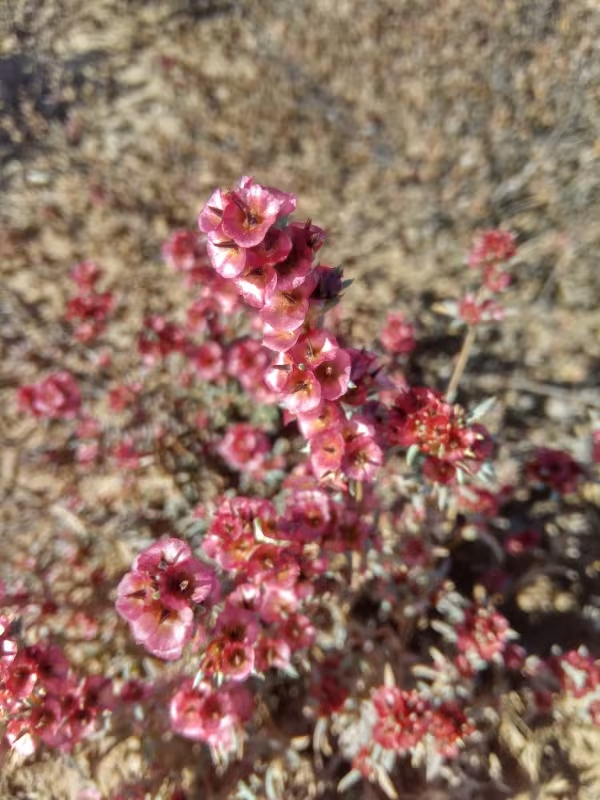
Description
Sowing dates
Sowing of Climacoptera brachiata is carried out in the early spring period, when the soil warms up to a temperature of 8–10 degrees Celsius. To obtain uniform emergence, seeds should be placed at a depth of no more than 1–2 centimeters, due to their small size.
Under natural conditions in desert zones, the plant propagates by self-seeding; however, when introducing it into cultivation, it is important to observe a seeding rate of about 4–6 kilograms per hectare. Using precision seeders allows for even distribution of seeds across the field.
Row sowing with a spacing of 30–45 centimeters is considered optimal, providing the plant with enough space for root system development. In irrigated agriculture, sowing is possible in tighter time frames to maximize moisture utilization.
After sowing, it is recommended to perform light soil rolling to improve the contact between seeds and the soil substrate. In arid regions, it is important to provide initial irrigation if natural rainfall levels are below the norm.
Young plants develop quite slowly in the first weeks of life, so it is critical to control the absence of weeds in the rows until the leaves close up.
Growing requirements
Climacoptera brachiata belongs to the Amaranthaceae family and is a typical halophyte capable of growing in soils with a high degree of salinity. This makes the crop a valuable object for the biological reclamation of degraded lands.
The crop is extremely demanding of light and does not tolerate shading at any stage of its growth cycle. It prefers open, sunny areas with good air circulation, which reduces the risk of fungal diseases.
The plant does not place high demands on the mechanical composition of the soil, successfully adapting to both sandy and loamy soils. The main requirement is the absence of stagnant groundwater in the root zone.
The optimal temperature range for active growth is between 25 and 35 degrees Celsius. The plant has exceptional heat resistance and is capable of accumulating osmotically active substances to survive in extreme environments.
In the agronomy of this crop, an important aspect is the chemical composition of the soils, where it shows a tendency to accumulate salts, which determines its specific economic use in fodder production.
Yield
The yield of green mass of Climacoptera brachiata directly depends on the level of moisture during the growing season and can vary within a wide range. With sufficient atmospheric moisture or limited irrigation, the indicator reaches 15–20 centners per hectare.
In irrigated desert conditions, the yield is significantly lower and depends on the intensity of spring rainfall. The plant has the ability to recover quickly after partial grazing by livestock or moderate mowing.
To increase the productivity of the crop, the application of micronutrients is used; however, an excess of nitrogen compounds can lead to a change in the biochemical composition of the greens. Maintaining balanced nutrition with an emphasis on phosphorus-potassium complexes is considered optimal.
The seed mass from one hectare averages 1.5–2 centners, which allows for annual renewal of plantings if collection technologies are observed. Seed harvesting is carried out in the phase of full maturity, when they acquire their characteristic color.
The economic efficiency of cultivation is due to the low cost of field maintenance and the lack of need for complex technical operations characteristic of cereal crops.
Main diseases and pests
The main pests for Climacoptera brachiata are various species of desert locusts, capable of destroying a significant part of the crop in a short time. Insecticidal treatment is carried out only in outbreaks of mass reproduction.
Diseases in this species are relatively rare, which is associated with the high concentration of salts in the plant tissues. However, in high humidity conditions, the development of root rots caused by fungi of the genera Fusarium and Rhizoctonia is possible.
Among other threats, one should highlight field rodents that damage the root collar of young plants at the beginning of the season. Regular field inspection allows for the timely detection of pest presence signs.
To minimize phytosanitary risks, it is recommended to observe crop rotation, excluding the continuous cultivation of halophytes on the same plot for more than three years in a row.
The seedling stage is considered the most critical period, where any mechanical damage or insect infestation can lead to the complete death of sprouts in the area.
Harvesting
Harvesting for green mass is carried out before the beginning of stem lignification, which usually occurs during the flowering phase. Early harvesting ensures the maximum concentration of nutrients and better digestibility of the feed by animals.
Mowing is carried out with standard mowers with or without a shredder, depending on the further method of using the crop. Often, it is used as pasture feed during moderate grazing, which allows for extending the period of field use.
To obtain seed material, harvesting is carried out using a two-stage method, mowing plants into windrows for ripening. After the windrows dry, threshing is performed, which helps prevent seed shedding while standing in the field.
During the harvesting process, it is important to monitor the humidity of the plant mass to avoid spontaneous combustion or spoilage during storage in stacks. The optimal humidity for storage should not exceed 15-18 percent.
Post-harvest seed processing includes cleaning from impurities and drying to the standard humidity level. High-quality prepared seeds retain high germination for up to two-three years under proper storage temperature conditions.