
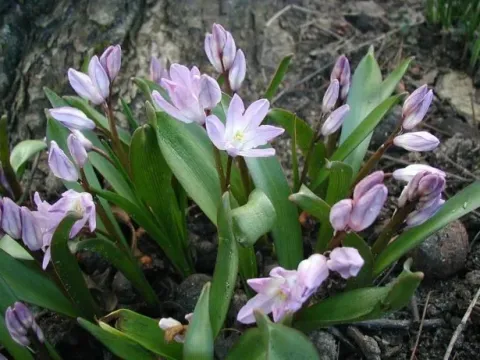
Chionodoxa
Chionodoxa Boiss.
Chionodoxa (Chionodoxa Boiss.), a member of the Asparagaceae family, is a bulbous perennial typically planted in late summer or early autumn, generally between August and September.
What the section contains


Chionodoxa
Bulbs should be planted at a depth of 5 to 8 centimeters, maintaining a spacing of 5–10 centimeters between individual plants to ensure proper airflow and development.
The culture can be propagated vegetatively through the division of bulb clusters, which should be performed immediately after the foliage has turned yellow and withered.
While seed propagation is possible, it is less common due to the extended development cycle; plants grown from seeds usually take three to four years to reach their first bloom.
Selecting healthy, firm bulbs without signs of mechanical damage or fungal infection is essential for achieving vigorous growth and uniform flowering in the upcoming season.
Chionodoxa is highly adaptable to various lighting conditions, though it thrives best in sunny spots or partial shade where the soil warms up early in the spring season.
The plant prefers loose, fertile, and well-drained loamy soils with a neutral or slightly acidic pH. Avoiding waterlogged areas is critical to prevent the bulb from rotting during the dormant phase.
As a hardy perennial, Chionodoxa demonstrates excellent frost resistance, allowing it to survive harsh winters in most temperate regions without the need for additional cover.
Regular moisture is beneficial during the active growth period; however, once flowering finishes and leaves die back, watering should be reduced as the plant enters its rest cycle.
Cultural practices include occasional soil loosening to improve oxygen levels and vigilant weed management to ensure the small plants are not suppressed by more aggressive species.
The primary economic and aesthetic value of Chionodoxa lies in its role as a premier early-spring ornamental, blooming immediately as snow begins to melt.
It is widely utilized in landscape design for creating dense, colorful carpets in rock gardens, woodland borders, and along walkways, adding early interest to any landscape.
Applying balanced mineral fertilizers at the beginning of the growth cycle significantly enhances flower production and improves the overall vitality of the plant clumps.
Given the right conditions, Chionodoxa spreads effectively, forming large, attractive colonies that do not require frequent disturbance or division for several years.
The species is also valued in commercial floriculture for its potential in greenhouse forcing, providing fresh blossoms for indoor display during the late winter months.
The most significant pathological threats to Chionodoxa are fungal diseases, including gray mold and Fusarium rot, which are primarily exacerbated by excessive soil moisture.
Among animal pests, rodents such as mice and voles pose a major threat, as they often consume the nutrient-rich bulbs during the dormant winter period.
The bulb mite is another harmful pest that can penetrate the scales of the bulb, causing structural damage and secondary infections that lead to plant decline.
Proactive management includes treating bulbs with appropriate fungicides prior to planting and ensuring that the planting site has adequate drainage to discourage pathogen proliferation.
- Gray mold (Botrytis)
- Fusarium rot
- Bulb mite
- Rodent damage