
Mountain misery
Chamaebatia foliolosa
Description
Growing requirements
Mountain misery (Chamaebatia foliolosa) is a low-growing evergreen shrub belonging to the Rose family (Rosaceae). Native to the Sierra Nevada mountains, this plant typically thrives in forested areas, forming dense carpets on the forest floor.
The species requires well-drained, sandy or rocky soils to prevent root rot. It is highly adapted to nutrient-poor substrates, making it an excellent candidate for sites where other vegetation might struggle to survive.
Regarding climate, the plant is hardy and well-suited to Mediterranean-type climates. It possesses a deep taproot system, allowing it to withstand long periods of drought once the plants are well-established in the field.
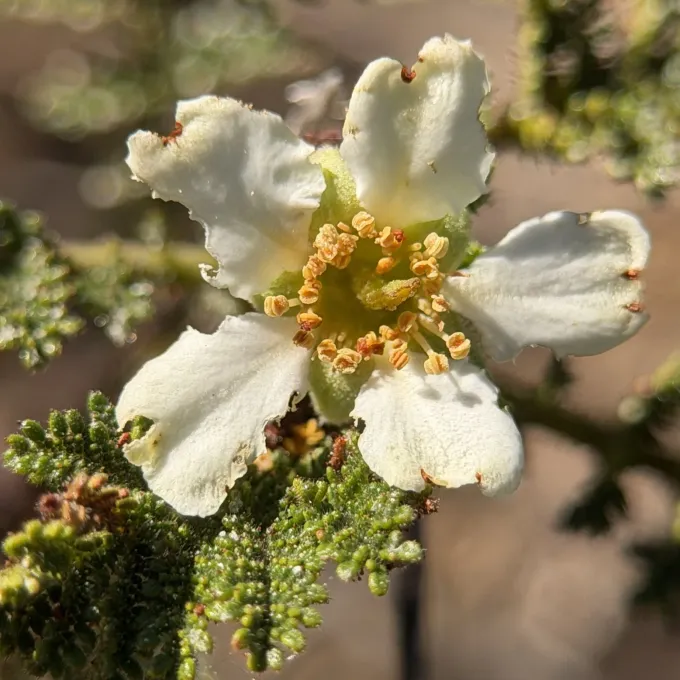
Botanically, it is known for its finely divided, fern-like leaves and attractive white flowers. This structural density makes it highly effective at suppressing weeds and preventing soil erosion in sloping terrains.
Agrotechnical management is relatively simple due to its natural resilience. Once the stand is established, the plant requires little to no fertilization or irrigation, making it a sustainable choice for reclamation projects.
Main diseases and pests
The most significant threat to the health of the plant is poor soil drainage. Waterlogged soils lead to rapid fungal decay of the root system, which is often irreversible once symptoms appear.
In humid microclimates, the foliage may be susceptible to mildew if air circulation is inadequate. Planting at appropriate densities is crucial for maintaining the vigor of the stand.
Insect pests are generally not a major concern due to the plant's aromatic resinous compounds, which act as a natural deterrent against most herbivorous insects.
During extreme heatwaves accompanied by dry winds, younger plants may suffer from leaf scorching, though this is rarely fatal for established specimens.
Integrated pest management in nurseries should focus on maintaining a dry crown and ensuring that the irrigation schedule does not overlap with high humidity periods.