
Chaenactis stevioides
Chaenactis stevioides
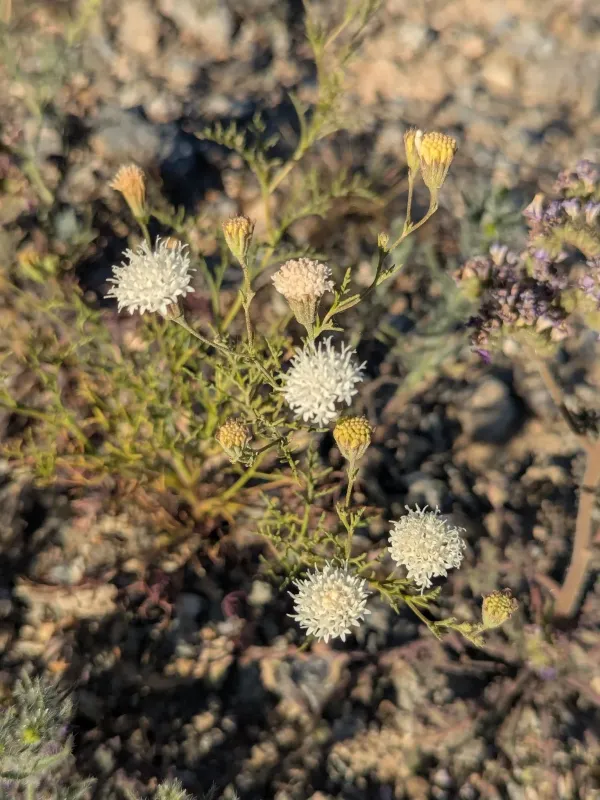
Description
Growing requirements
Chaenactis stevioides, commonly known as the desert pincushion, belongs to the Asteraceae family. It is a hardy annual herb native to the southwestern United States and northwestern Mexico, specifically adapted to arid and semi-arid environments.
The plant thrives in sandy or gravelly soils where drainage is excellent. Its geographical range primarily covers the Mojave Desert and the Great Basin, where it is found in open, sunny habitats with minimal competition from other vegetation.
Botany-wise, the plant typically grows between 10 and 40 centimeters tall. It possesses dissected, pubescent leaves that minimize water loss through transpiration, and it produces flower heads that bloom after seasonal spring rains.
Climate requirements include high solar intensity and low relative humidity. As a desert-adapted species, it demonstrates remarkable drought tolerance but requires a specific window of precipitation to trigger germination and early growth.
Economically, while not a commercial staple, it serves a critical role in ecological restoration and erosion control in arid landscapes. Its ability to colonize degraded soils makes it a candidate for low-maintenance landscaping and biodiversity preservation.
Main diseases and pests
The primary threat to Chaenactis stevioides in an agricultural or managed setting is root rot caused by poor soil drainage. When grown in heavy clay or saturated soils, the plant quickly succumbs to fungal pathogens.
Pests that occasionally affect the plant include aphids and leaf-feeding caterpillars. These are generally managed through integrated pest management techniques, as the plant is sensitive to harsh chemical pesticides.
Competition from invasive weed species represents a major challenge during the seedling stage. In its native habitat, invasive grasses often outcompete the desert pincushion for limited resources, significantly reducing native population density.
Temperature stress, particularly late frosts during the early spring development phase, can cause irreversible damage to the growing tips. Protecting the young plants from extreme cold is essential for successful stand establishment.
Environmental degradation, such as off-road vehicle activity and overgrazing, poses a structural threat to the delicate soil crusts where this plant relies on to maintain its natural habitat and reproductive cycle.