
Quindio wax palm
Ceroxylon quindiuense
Description
Growing requirements
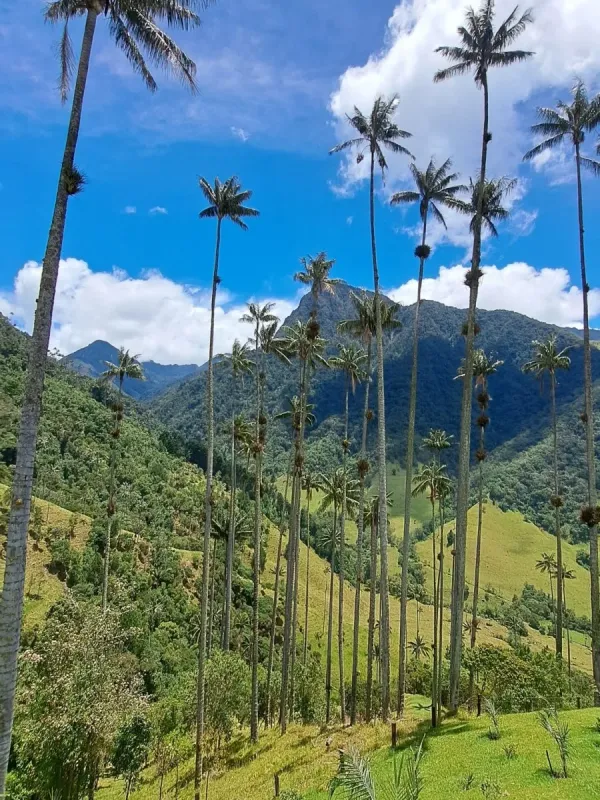
The Quindio wax palm (Ceroxylon quindiuense) is a member of the Arecaceae family and is widely recognized as the national tree of Colombia. It is distinguished by being one of the tallest palm species on Earth, reaching heights of up to 60 meters.
This species is native to the Andean regions of Colombia, primarily thriving in the Cocora Valley. It is uniquely adapted to high-altitude environments, generally growing between 2,000 and 3,000 meters above sea level where temperatures are cool and humidity is high.
The palm requires well-drained soils and thrives on steep mountain slopes. It is highly resistant to low temperatures and thrives in a misty, temperate climate. It is not suitable for tropical lowlands or hot, arid environments.
Botanically, the species features a smooth, slender trunk covered in a thick layer of natural wax. Its pinnate leaves form an expansive canopy, providing an essential habitat for various mountain birds and insects throughout the year.
Historically, the wax from its trunk was harvested for candle making, but modern usage has shifted toward conservation and ecotourism. It is a flagship species for biodiversity protection in its native region, with strict laws governing its preservation.
Main diseases and pests
The primary threat to the Quindio wax palm is habitat loss caused by agricultural conversion. Livestock grazing in its native range is particularly destructive, as cattle consume or trample young seedlings, preventing natural regeneration.
The slow growth rate of the palm is a biological challenge for conservation efforts. It takes many decades for a tree to reach reproductive maturity, meaning that even small disturbances in the habitat can have long-lasting effects on population stability.
Climate change poses a significant risk to the species. As temperatures rise in high-altitude Andean valleys, the specific environmental niche required for these palms to germinate and survive is shifting or shrinking, endangering local populations.
While mature trees are generally resilient, saplings in controlled nurseries can be susceptible to root rot and fungal infections if soil conditions become waterlogged. Proper drainage and aeration are critical for propagation.
Conservation strategies currently focus on land protection and the restriction of harvesting branches for religious festivals. Educating local populations on the long-term ecological value of the species remains crucial for its survival.