
Cashew
Anacardium occidentale L.
Description
Sowing dates
Cashew propagation is primarily achieved through vegetative methods like grafting, which ensures the consistency of desired traits and promotes faster maturation compared to planting seeds.
When using seeds, they are sown in a nursery during the onset of the rainy season to benefit from high humidity levels, which are essential for successful germination and early development.
Seedlings are nurtured in containers with high-quality substrate for 6 to 12 months, providing them with necessary partial shade until they become robust enough to withstand outdoor conditions.
Planting in the orchard is conducted with a spacing between 10 and 12 meters, allowing the trees enough space to spread their broad, dense crowns as they reach maturity over the years.
Careful site selection and preparation, including the incorporation of organic matter into the planting holes, are crucial for ensuring the rapid establishment of the root system in the field.
Growing requirements
Cashew, belonging to the Anacardiaceae family, is a tropical tree that thrives in warm, humid climates with well-defined dry seasons, which are essential for the flowering and fruit-setting stages.
The ideal temperature for cashew growth ranges from 20 to 35 degrees Celsius, as the plant is highly sensitive to cold and will suffer irreversible damage if exposed to frost or near-freezing conditions.
While the tree is known for its remarkable drought tolerance, adequate water supply during the development stages significantly impacts the overall yield and quality of the nut harvest.
Cashew trees perform best in well-drained, sandy, or sandy-loam soils; they are notably intolerant to waterlogged conditions, which can lead to rapid root rot and tree decline.
Full sun exposure is mandatory for the plant, as any significant amount of shade can lead to leggy growth, reduced flowering, and a substantial decrease in fruit production over time.
Yield
The commercial lifespan of a cashew tree begins about 3 years after planting, with the tree reaching its peak productivity after a decade, sustaining high yields for several decades thereafter.
The annual harvest from a healthy adult tree can range from 5 to 15 kilograms of raw nuts, depending on environmental conditions, variety, and the level of agronomic management applied.
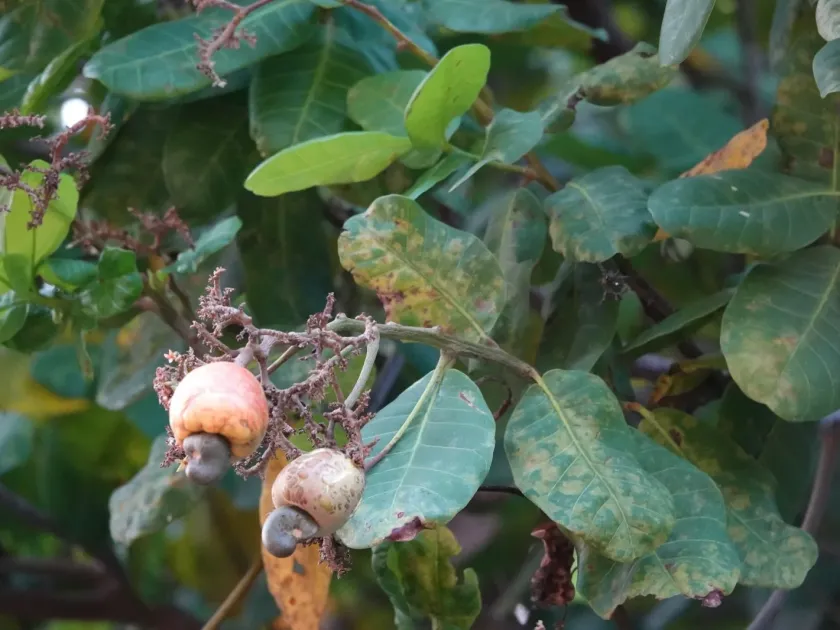
The fruit complex consists of the cashew apple, which is the fleshy, colorful part, and the true fruit, which is the nut located at the base of the apple in a thick, toxic shell.
Cashew apples are highly perishable but are utilized in various industries to produce nutritious juices, syrups, and fermented beverages, adding significant value to the farming operation.
The processing of the nut shell is a sophisticated industrial stage, as the liquid extracted from the shell, known as Cashew Nut Shell Liquid (CNSL), is a valuable industrial chemical.
Main diseases and pests
Insect pests, such as the tea mosquito bug and leaf-webbers, represent a major concern, as they feed on succulent plant tissues and flowers, leading to significant potential losses.
Anthracnose is the most serious fungal disease affecting cashews, causing necrotic spots on leaves and panicles, particularly under high humidity, which can lead to blossom blight.
Integrated pest management strategies are essential, involving the judicious use of biopesticides, regular field monitoring, and the removal of diseased branches to limit the spread of pathogens.
Regular orchard maintenance, including weed control and proper canopy management, helps maintain tree vigor and reduces the micro-environmental conditions conducive to pest outbreaks.
- Regular canopy pruning to improve airflow.
- Monitoring for symptoms of fungal infection.
- Promoting natural predators to keep pest populations low.
Harvesting
Harvesting usually involves picking mature apples that have fallen naturally to the ground or collecting them when they change color and become easily detachable from the stalk.
Timely collection is vital to prevent fruit rot; once gathered, the nuts are separated from the apples and sun-dried for several days to ensure they reach the target moisture content.
Properly dried raw nuts are stable and can be stored in clean, cool, and well-ventilated areas for several months before being transported for mechanical or manual processing.
The extraction of the kernel from the hard shell is a delicate operation requiring specialized machinery or careful manual labor to avoid contact with the caustic resins found in the shell.
Workers must wear protective clothing throughout the post-harvest phase to prevent chemical burns or skin irritation caused by the natural oils released during the shell-breaking process.