
Giant sandreed
Calamovilfa gigantea
Description
Growing requirements
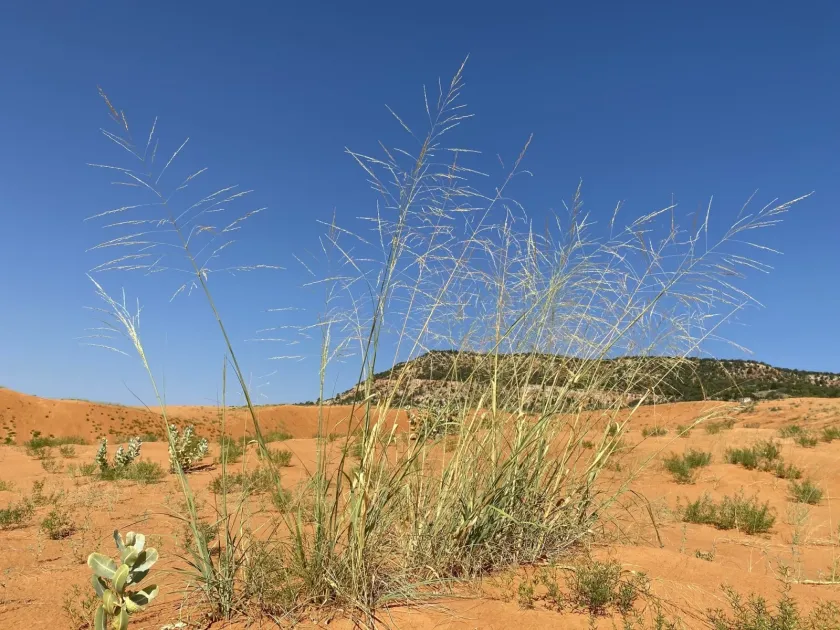
Calamovilfa gigantea, commonly known as Giant sandreed, is a robust perennial grass belonging to the Poaceae family. It is characterized by its significant height and extensive, deep-reaching rhizomes that allow it to stabilize loose sandy environments effectively.
Originating from the central plains of North America, this plant is well-adapted to arid environments. Its primary ecological role is to act as a pioneer species in sandy dunes, where it thrives despite intense sun exposure and nutrient-poor soils.
The soil requirements for this crop are specific; it necessitates well-drained, porous soils. It is highly intolerant of waterlogging, which can quickly damage the root system. Consequently, it performs best in sandy textures with excellent aeration.
Climatically, it prefers regions with warm summers and cold winters. It is highly drought-tolerant, utilizing its physiological adaptations to survive long periods without precipitation, making it a valuable asset for land management in arid climates.
Agricultural use focuses primarily on phytoremediation and soil conservation. By planting Giant sandreed, land managers can successfully prevent wind erosion and stabilize slopes in ecologically sensitive or degraded regions.
Main diseases and pests
Potential threats include various fungal pathogens that can develop under conditions of high humidity and poor air circulation. While the plant is hardy, prolonged exposure to stagnant water will lead to crown and root rot.
Insect pests are generally less impactful on established stands due to the coarse and fibrous texture of the foliage. However, young plants may be susceptible to localized damage from larvae during the initial establishment phase.
Invasive competition represents a major threat during the seeding and early growth stages. Without proper weed management, aggressive species can easily outcompete young sandreed for resources, limiting its development.
Overgrazing is another significant risk, as continuous removal of the above-ground biomass depletes the energy reserves stored in the rhizomes, leading to a decline in plant vigor over several seasons.
To ensure long-term success, practitioners should avoid over-fertilization, as this can alter the balance between vegetative growth and the deep root structure that is vital for this species' survival in sandy soils.