
Mangifera foetida
Mangifera foetida Lour.
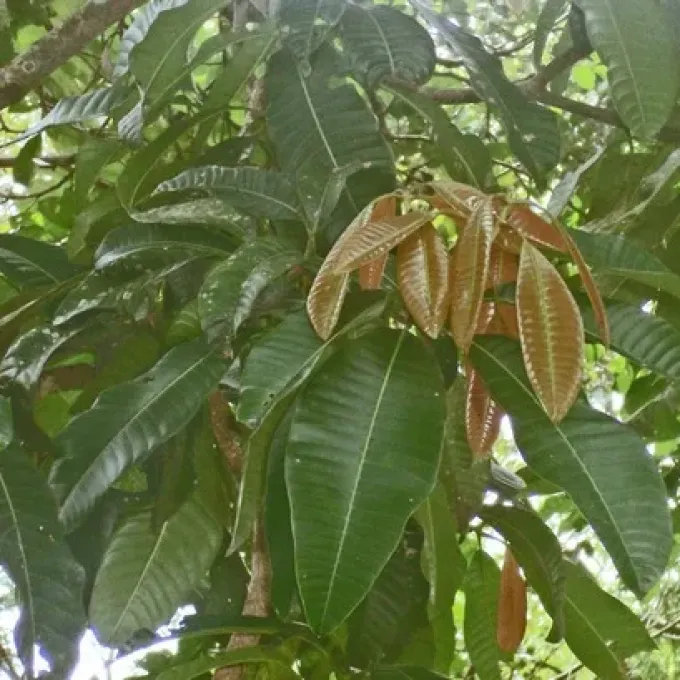
Description
Sowing dates
Mangifera foetida, commonly known as horse mango, belongs to the Anacardiaceae family. It is a large, evergreen tree propagated primarily through seeds, which maintain high viability if sown immediately after extraction from the fruit.
Seeds are sown in nursery beds with high moisture content. Given their recalcitrant nature, they must not be allowed to dry out, as this significantly reduces germination rates and seedling vigor.
Seedlings are transplanted to the field after 18 to 24 months. A planting distance of 10x10 meters is recommended to accommodate the tree's massive canopy development over its long lifespan.
Field preparation involves deep soil tillage and the addition of organic matter to support root establishment. Initial shade is often provided to protect young saplings from intense tropical heat.
Field maintenance focuses on weed control within the drip line to ensure that young trees do not compete for nutrients, especially during the early stages of establishment.
Growing requirements
This species thrives in humid tropical climates, requiring consistent temperatures between +25°C and +35°C. High atmospheric humidity is essential for optimal vegetative growth and health.
Deep, fertile, well-drained loamy or sandy soils are ideal. The species is sensitive to waterlogging, so proper drainage infrastructure is critical in regions with heavy seasonal rainfall.
While the tree can adapt to various soil types, high organic content significantly boosts its productivity. Full sunlight is necessary for flower induction and high-quality fruit production.
The tree is intolerant of saline soils and prolonged drought without supplemental irrigation. In commercial orchards, drip irrigation is employed to manage moisture levels during the dry season.
Fertilization regimes prioritize nitrogen for vegetative growth and potassium for fruit development, applied twice annually to coincide with the onset of the rainy season.
Yield
Productivity varies based on tree age and management practices. Seedling-derived trees typically begin to bear fruit within 6 to 8 years, reaching their peak production phase in maturity.
A healthy, mature tree can produce between 150 and 300 kilograms of fruit per season. Fruit clusters are heavy, requiring careful management to prevent limb breakage during the development phase.
Yield cycles may show some degree of biennial bearing. Pruning techniques that remove dead wood and encourage lateral branching are effective in stabilizing the annual production output.
Orchard longevity is exceptional, with productive life spans exceeding 50 years. As trees grow larger, mechanical aids are required to manage the canopy and assist in harvesting.
Economic potential is highest in regions where local market demand for traditional and culinary uses of the fruit is strong, given its unique flavor and aromatic profile.
Main diseases and pests
Fruit flies are the most significant pest, targeting developing fruit and causing severe economic loss if not controlled. Integrated pest management using pheromone traps is standard practice.
Anthracnose, caused by fungi, affects leaves and fruit during periods of prolonged humidity. Maintaining an open canopy through regular pruning improves airflow and reduces fungal incidence.
Scale insects and mealybugs can infest succulent stems, weakening the tree and promoting sooty mold development on the foliage. Early detection and treatment are vital for plant health.
- Anthracnose (Colletotrichum gloeosporioides)
- Fruit fly (Bactrocera species)
- Mealybugs and scale insects
- Root rot (Phytophthora spp.)
Disease management relies on a combination of cultural practices, such as proper spacing and sanitation, and judicious use of biopesticides when thresholds are exceeded.
Harvesting
Harvesting is performed manually when the fruit reaches technical maturity, signaled by the distinct, strong, pungent aroma and skin softening. The fruit is typically picked by hand using long poles.
Because the fruit is soft and perishable, it must be handled with care to prevent bruising. Rapid movement from the orchard to the marketplace is essential to maintain fruit quality.
Post-harvest grading ensures only damage-free fruits reach consumers. The fruit is popular for its use in chutneys, traditional sauces, and pickling, where its strong flavor is considered a benefit.
Storage life at room temperature is short, rarely exceeding a few days. Cold storage can slightly extend this period, but the species is generally treated as a fresh, immediate-market commodity.
Harvesting strategies often involve picking fruit slightly early if long-distance transport is required, although this sacrifices some of the characteristic flavor profile of the horse mango.