
Aetanthus mutisii
Aetanthus mutisii
Description
Growing requirements
Aetanthus mutisii is a flowering plant belonging to the Loranthaceae family. It is recognized as a hemiparasite that maintains an epiphytic existence, attaching itself to host trees to survive in its native Andean mountain environments.
Native to the high-altitude forests of South America, this species thrives in conditions characterized by high humidity and moderate temperatures. The plant utilizes specialized structures called haustoria to derive water and essential minerals from the host vascular system.
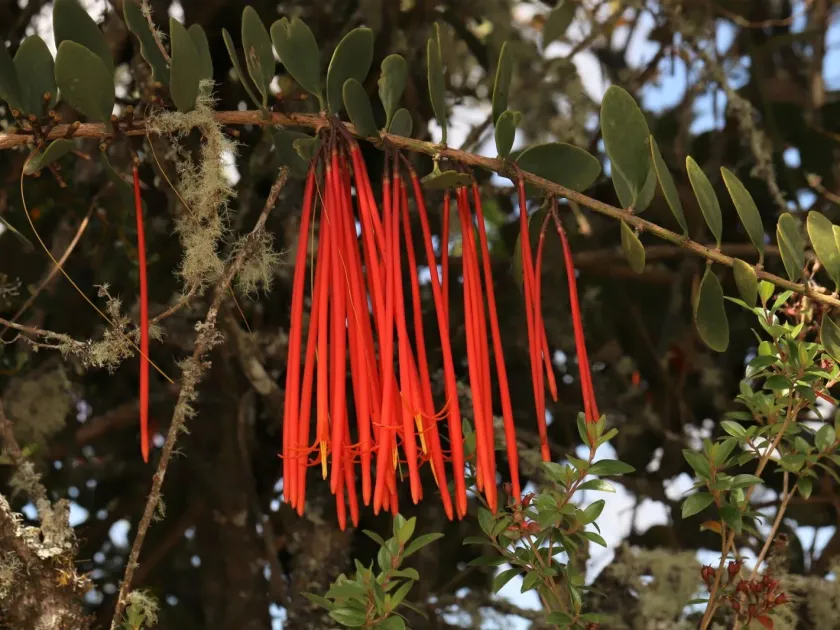
The morphology of the plant includes leathery leaves and branched stems designed to withstand high-altitude exposure. Since it lacks traditional root systems for soil absorption, it relies entirely on its parasitic connection to the host branch.
Growth is typically slow and depends on the presence of suitable host tree species. The plant is perfectly adapted to the mist-heavy cloud forests of the Andes, where it plays a subtle role in the local forest ecosystem architecture.
Reproduction is facilitated by avian vectors that disperse the sticky seeds onto branches. This interaction is essential for the colonization of new hosts and the long-term expansion of the species within its natural range.
Main diseases and pests
The primary threat to Aetanthus mutisii is the destruction of natural Andean forests. As host trees are cleared for agricultural expansion or urban development, the population of this parasitic plant declines rapidly.
Climate change poses a significant risk to the species by altering the humidity levels of the cloud forest zones. Since the plant is highly specialized, even minor shifts in moisture availability can hinder its ability to establish on new hosts.
Fungal pathogens affecting the host trees can indirectly jeopardize the survival of the parasite. Once the host's bark integrity is compromised by disease, the structural foundation for the Aetanthus colony is lost.
While the plant possesses natural chemical defenses against many generalist insects, it lacks resilience against large-scale environmental degradation. Habitat fragmentation breaks the chain of dispersal, preventing the species from migrating to more stable areas.
Conservation efforts must focus on maintaining the health of the Andean forest ecosystems. Without strict protection of host tree habitats, Aetanthus mutisii faces the risk of localized extinction due to the loss of its obligate life-support systems.