

Description
How to tell it apart
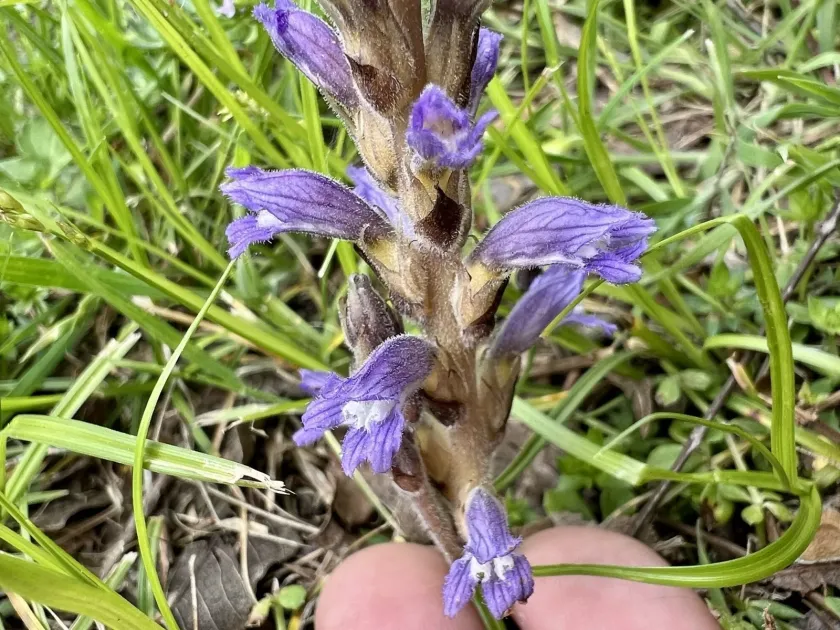
Branched broomrape is an obligate root parasite belonging to the Orobanchaceae family. The plant is entirely devoid of chlorophyll, which gives its stems a pale yellow, brownish, or purplish hue, making it distinct from typical field weeds.
Outwardly, this parasite appears as a fleshy, upright stem, branching from the base, reaching 10 to 30 centimeters in height. Its leaves are reduced to small, alternate scales arranged along the stem.
The inflorescence is a loose spike consisting of numerous tubular flowers. The color of the corolla varies from bluish-violet to nearly white, often featuring characteristic darker veins.
The root system of the broomrape is modified: it forms specialized suckers called haustoria, which penetrate the host plant's roots to extract water and nutrients. The plant lacks its own functional roots for soil nutrient uptake.
The fruit is a capsule containing a vast number of microscopic, dust-like seeds that remain viable in the soil for 10–12 years and are easily dispersed by wind, irrigation water, or farm machinery.
Where it grows
Branched broomrape is a thermophilic parasite, widely distributed in warm regions where vegetable and oilseed crops are cultivated. It favors light, well-drained, and warm soils.
The primary host crops for this species include tomatoes, tobacco, hemp, sunflowers, peppers, potatoes, and various legumes. In these crops, the parasite can cause devastating yield losses.
The weed is frequently found on non-arable land and along roadsides, where it parasitizes wild members of the Solanaceae family, creating a permanent source of infection for adjacent agricultural fields.
Seed dispersal occurs highly efficiently: due to their extremely small size, the seeds are easily transported via soil particles on tractor tires and combine harvesters, as well as through irrigation channels.
For germination, broomrape seeds require specific chemical signals known as root exudates from host plants. If no suitable host plant is present in the soil, the seeds remain in a state of deep dormancy.
Harm it causes
The damage caused by branched broomrape stems from the direct depletion of host crops. By attaching to the roots, the parasite siphons off water, minerals, and photoassimilates, which severely stunts the host's growth and development.
Heavy infestation leads to yellowing of the foliage, inhibited flowering, and poor fruit set. In critical cases, affected plants wither prematurely, failing to yield a marketable harvest.
Yield losses for vegetable crops like tomatoes or tobacco can reach 50–80% or more, making farming in heavily infested areas economically unviable without the implementation of radical control strategies.
Beyond direct quantitative damage, broomrape degrades produce quality: fruits become undersized, and the content of sugars and dry matter decreases, significantly reducing the market value of the crop.
A particular danger of this parasite is its cryptic development; by the time the broomrape stalks appear above the soil surface, the majority of the damage to the host has already occurred, making it nearly impossible to save the current season's yield.
How to control
The primary control strategy is the implementation of long-term crop rotation using non-host species, such as cereals or corn, for a period of up to 10 years to exhaust the soil seed bank of the parasite.
An effective agrotechnical practice involves the use of trap crops—planting species that stimulate the germination of broomrape seeds but do not allow the parasite to attach, after which the trap crop is plowed under.
Strict phytosanitary measures are essential, including the cleaning of farm machinery after working in infested areas and the use of certified, clean seed lots to prevent the accidental introduction of the parasite.
Chemical control is possible through the use of systemic herbicides containing imidazolinones, provided that herbicide-tolerant crop hybrids (e.g., Clearfield sunflower technology) are grown.
Biological control methods include the use of the phytomyza fly, which lays eggs in the broomrape seed capsules, leading to the destruction of a significant portion of the parasite's seeds and suppressing its future spread.
Content graph
Connections · Branched broomrape
Most often together:
Marketplace
Products · 1
Biology
Taxonomy
- Latin name
- Phelipanche ramosa
- Family
- Заразиха подсолнечниковая