
Clearweed
Pilea pumila
Description
How to tell it apart
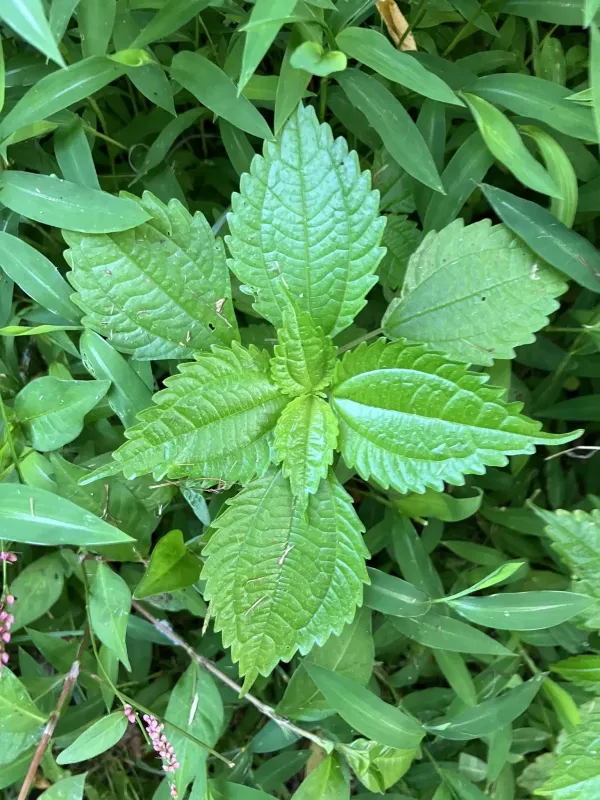
Clearweed (Pilea pumila) is a member of the Urticaceae family. It is an annual herbaceous plant often confused with nettle, although it lacks stinging hairs and is harmless to the touch.
The stem of the plant is succulent, semi-translucent, smooth, and branched at the base, typically reaching heights of 10 to 50 cm. Leaves are opposite, ovate or elliptical, with serrated margins and long stalks.
Flowers are arranged in axillary clusters; they are very small, unisexual, and inconspicuous with a greenish hue. The flowering phase usually occurs from mid-summer through early autumn.
The root system is fibrous and shallow, making individual plants easy to pull up, yet the species produces vast amounts of seeds, ensuring rapid propagation throughout a growing season.
Seeds are small, elliptical achenes that are easily transported by water runoff and agricultural machinery, making the weed difficult to eradicate once it establishes itself.
Where it grows
Clearweed prefers shaded, damp, and nutrient-rich environments. It is naturally found in forest floors, riverbanks, and shaded areas of garden beds or damp landscapes.
In agriculture, it is a significant nuisance in greenhouse environments and irrigated vegetable plots where high humidity and shade facilitate its aggressive spread.
The weed thrives in soils with high organic matter, frequently colonizing fields under canopy crops or dense vegetable plantings where ground evaporation is low.
Because of its tolerance for low-light conditions, it often outcompetes other plants in high-density crop rows where light penetration is limited.
Clearweed is also commonly found in disturbed sites, ditch banks, and drainage areas where stagnant water provides a constant moisture supply.
Harm it causes
The primary damage caused by Clearweed is competition for water and nutrients, which can significantly stunt the growth of young crops in their critical development stages.
By forming dense mats of vegetation, it traps moisture in the crop canopy, significantly increasing the risk of fungal pathogens and rots in sensitive agricultural crops.
It acts as an alternative host for various pests that can migrate to primary commercial crops, causing yield losses and requiring additional pest management interventions.
The presence of this weed complicates farm machinery operations and increases labor costs for manual weeding, which impacts the overall profitability of the operation.
Harvest contamination by Clearweed lowers the market value of the produce, as the presence of weed fragments is often prohibited in processed or fresh retail greens.
How to control
Cultural control is the most effective approach; regular tilling and soil cultivation destroy young seedlings before they reach the stage of seed production.
Managing the irrigation system to avoid localized waterlogging in between rows can effectively discourage the growth of this moisture-loving invasive species.
In large-scale farming, applying pre-plant herbicides can successfully eliminate early flushes of clearweed before the main crop is established.
- Applying mulch to prevent seed germination and inhibit light access.
- Manual rogueing before flowers produce mature seeds.
- Ensuring crop sanitation to prevent the introduction of new seed banks.
For persistent infestations, chemical controls, including selective post-emergence herbicides, may be used according to specific crop labels to provide reliable suppression.
Taxonomy
- Latin name
- Pilea pumila
- Family
- Крапива двудомная
- EPPO code
- PILPU