
Wild tobacco
Solanum mauritianum
Description
How to tell it apart
Wild tobacco (Solanum mauritianum) is a perennial shrub or small tree that typically grows up to 4 meters in height. It is easily identified by its large, elliptic leaves that are covered in dense, velvety, star-shaped hairs.
The plant features clusters of violet or purple flowers with distinctive yellow stamens, which are arranged in large, terminal corymbs.
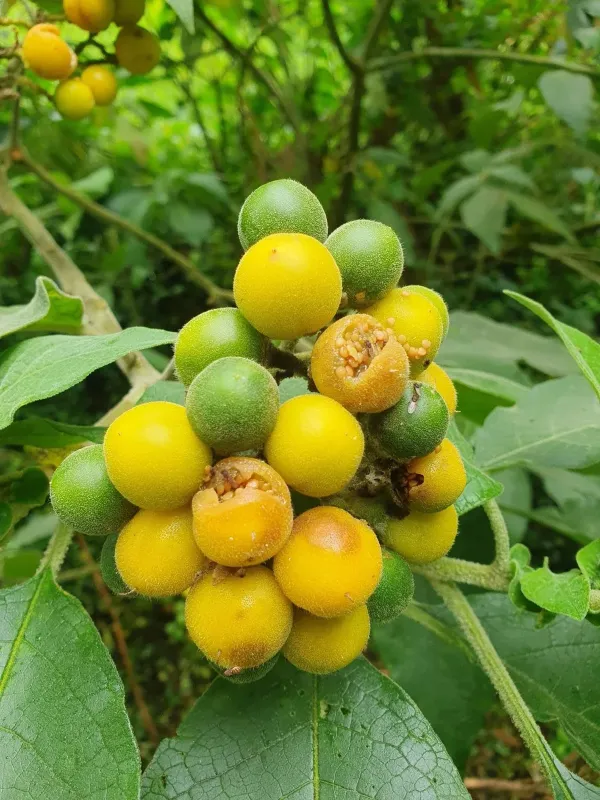
Its fruits are globular berries, green when immature, turning into a dull yellow color upon reaching full maturity, and are highly attractive to birds.
The stems of the plant are initially green and hairy, but as the plant matures, they become woody and grayish-brown in appearance.
The root system is robust and extensive, providing the plant with the ability to secure resources efficiently even in competitive environments.
Where it grows
This species is highly invasive and thrives in a variety of environments, including tropical, subtropical, and disturbed coastal habitats.
In agricultural settings, it commonly infests field margins, fallow lands, pastures, and orchard boundaries, where it can quickly establish dense, impenetrable stands.
It shows a preference for moist, fertile soils but exhibits remarkable ecological plasticity, allowing it to adapt to diverse light conditions and soil types.
The spread of the plant is primarily driven by seed dispersal through birds that consume the berries and deposit seeds across large agricultural landscapes.
It is often found in areas with high human activity, benefiting from the disturbance of soil and natural vegetation cover.
Harm it causes
Wild tobacco acts as a aggressive competitor for nutrients, water, and sunlight, leading to significant yield losses in adjacent crops.
It serves as a primary host for various pests and pathogens that specifically attack economically important solanaceous crops like tomatoes and potatoes.
The plant is toxic to livestock, and ingestion can lead to severe gastrointestinal distress and even mortality in cattle, sheep, and other farm animals.
The dense foliage of established stands creates deep shade, which effectively suppresses the growth of ground-cover plants and prevents natural forest regeneration.
Mechanical removal is labor-intensive and costly, posing a recurring financial burden on agricultural producers attempting to clear infested fields.
How to control
Management of Solanum mauritianum requires a combination of mechanical and chemical control strategies to ensure complete eradication.
Small plants can be hand-pulled when the soil is moist, but mature specimens require excavation to remove the entire root mass and prevent resprouting.
For larger infestations, the cut-stump technique using systemic herbicides is considered the most effective method to prevent regrowth from the rootstock.
Regular monitoring of field edges and agricultural land is essential to catch and remove seedlings before they reach reproductive maturity.
- Mechanical removal of the entire root system during early growth stages.
- Chemical treatment of cut stumps with appropriate systemic herbicides.
- Preventative measures including maintaining dense crop canopies to shade out seedlings.
Taxonomy
- Latin name
- Solanum mauritianum
- Family
- Паслён чёрный
- EPPO code
- SOLMR