
Solanum hoplopetalum
Solanum hoplopetalum
Description
How to tell it apart
Solanum hoplopetalum is a perennial weed belonging to the Solanaceae family. It is recognized for its robust growth habit and ability to persist in various environmental conditions, making it a difficult plant to manage.
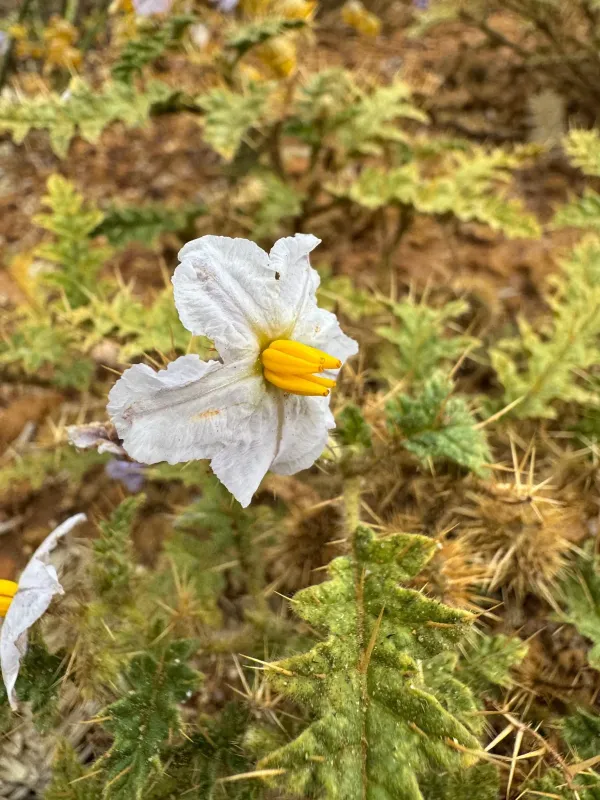
The plant is distinguished by prickly stems and leaf stalks, which are covered with sharp thorns. The leaves are typically lobed or dissected and feature fine hairs that provide a grayish-green appearance, common in many desert-adapted Solanum species.
Its flowers are relatively small, often white to pale violet, and clustered in inflorescences. Following pollination, the plant produces berries that contain numerous seeds, ensuring a high reproductive rate.
A primary characteristic of this species is its deep and extensive root system. This allows the plant to access deep water reservoirs and regenerate even after the above-ground parts have been removed by tillage.
The plant exhibits significant phenotypic plasticity, meaning it can adjust its growth rate and morphology based on local soil nutrient availability and moisture levels, contributing to its status as a resilient weed.
Where it grows
Solanum hoplopetalum is predominantly found in warm, arid, and semi-arid regions. It thrives in open agricultural fields, along roadsides, and in neglected lands where it can establish large, dominant colonies.
It often infiltrates cultivated areas such as row crops, cereals, and perennial pastures. Once established, it can easily spread through irrigation channels or wind dispersal of seeds across open landscapes.
The weed shows a preference for well-drained soils but is capable of surviving in poor soil conditions where most cultivated crops struggle to establish themselves. This gives it a competitive advantage in marginal agricultural areas.
Human activity is a major driver of its habitat expansion. The movement of contaminated farming equipment and the transport of agricultural products are the primary ways this weed finds its way into new territories.
Invasion often starts from field edges or irrigation ditches, where the lack of soil disturbance allows the weed to grow undisturbed until it eventually encroaches into the main cropping area.
Harm it causes
The damage caused by Solanum hoplopetalum is multi-faceted, primarily focusing on resource competition. It consumes significant amounts of nitrogen, phosphorus, and moisture, directly reducing the yield potential of crops.
This species serves as a reservoir for various plant pathogens. By hosting viruses and bacteria that affect related crops like potatoes and tomatoes, it acts as a constant source of reinfection within the field.
Its thorny nature creates physical hazards for agricultural workers and equipment. Harvesting machinery can be significantly damaged, and the time required for maintenance increases when working in fields heavily infested with this weed.
Product quality is severely degraded when weed seeds contaminate the grain harvest. This often leads to price penalties and the need for expensive post-harvest cleaning and sorting operations.
Furthermore, the dense stands of Solanum hoplopetalum can physically shade out emerging crop seedlings, leading to uneven crop stands and significant harvest losses at the end of the growing season.
How to control
Controlling Solanum hoplopetalum requires an integrated approach that combines mechanical cultivation with targeted chemical applications to ensure both the foliage and the root system are eliminated.
Mechanical control involves repeated deep tillage to weaken the root system. However, this must be timed carefully to prevent the dispersal of root fragments, which can lead to new infestations.
Chemical control typically involves the use of systemic herbicides. These agents are designed to be absorbed through the leaves and translocated to the roots, providing long-term suppression of the weed.
Integrated weed management also suggests using competitive cover crops in the off-season. These crops help shade the ground and prevent the germination of new seedlings by restricting access to sunlight.
- Implement a strict crop rotation schedule to break the weed's life cycle.
- Apply systemic herbicides during the active growth phase.
- Sanitize machinery thoroughly before moving from infested to clean fields.
- Monitor field boundaries and ditches to prevent initial encroachment.
Taxonomy
- Latin name
- Solanum hoplopetalum
- Family
- Паслён чёрный
- EPPO code
- SOLHO