
Giant knotweed
Reynoutria sachalinensis
Description
How to tell it apart
Giant knotweed is a perennial herbaceous plant from the Polygonaceae family, renowned for its impressive height and aggressive growth behavior in various environments.
The stems of the plant are hollow, node-bearing, and bamboo-like in appearance, often reaching heights of 3 meters within a single growing season, making it a prominent landscape feature.
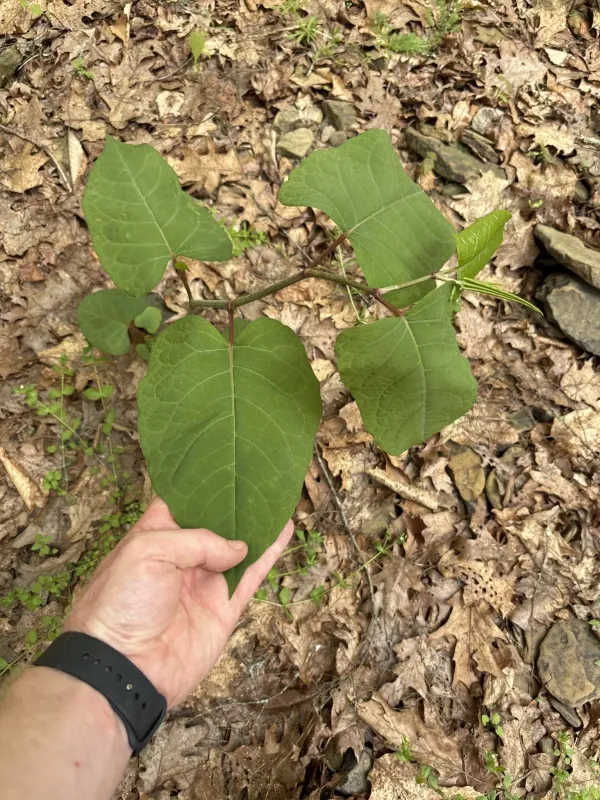
Leaves are large, broad, and heart-shaped at the base, arranged alternately along the stem, providing a dense canopy that shades out any competing vegetation underneath.
The root system is exceptionally robust, consisting of deep, far-spreading rhizomes that can penetrate hard soils and thrive deep underground, making traditional removal difficult.
Small, creamy-white flowers appear in large branched panicles during late summer, adding to the plant's massive reproductive potential through vegetative fragments.
Where it grows
Giant knotweed thrives in moist, nutrient-rich soils and is commonly found along riverbanks, roadsides, disturbed areas, and field margins where moisture is abundant.
In agricultural settings, it frequently invades fallow land, fence lines, and drainage ditches, gradually encroaching upon cultivated crops and reducing land productivity.
The plant demonstrates high adaptability to varied soil types, ranging from silty floodplains to compact clays, allowing it to colonize diverse landscapes with ease.
Once established, the plant spreads primarily through fragmented rhizomes, which are often transported by water or agricultural machinery to clean field areas.
It is commonly found bordering residential areas or old farmsteads, where it was originally introduced for ornamental purposes before escaping into the wider environment.
Harm it causes
The primary agricultural impact of Giant knotweed is its ability to form dense, impenetrable stands that completely suppress native plants and crops by monopolizing sunlight.
The massive rhizome network actively competes with crop roots for essential water and mineral nutrients, significantly stressing neighboring cultivated plants.
Giant knotweed releases allelopathic chemicals into the surrounding soil, which effectively inhibit the germination and growth of other plant species, ensuring its dominance.
In terms of physical impact, its strong growth can cause structural damage to irrigation infrastructure, pathways, and farm buildings, leading to increased maintenance costs.
High biomass production hinders mechanical harvesting and field maintenance, often leading to equipment damage and forcing farmers to spend more time on land clearing.
How to control
Mechanical control focuses on repeated cutting or mowing of the above-ground biomass, which must be performed consistently over several years to starve the rhizome system.
Excavation is only feasible for very small patches; however, great care must be taken to remove every fragment of the rhizome to prevent rapid regrowth from small pieces.
Chemical control involving systemic herbicides is the most reliable method for larger infestations, typically applied during the flowering stage for optimal translocation to roots.
Professional management often requires a multi-year strategy, combining selective herbicide applications with landscape monitoring to ensure no new shoots emerge.
- Continuous mowing to deplete rhizome energy reserves.
- Systemic herbicide application during the late flowering period.
- Careful disposal of plant material to prevent accidental spread to new areas.
Taxonomy
- Latin name
- Reynoutria sachalinensis
- Family
- Гречишка вьюнковая
- EPPO code
- REYSA