
Douglas knotweed
Polygonum douglasii
Description
How to tell it apart
Douglas knotweed (Polygonum douglasii) belongs to the Polygonaceae family. It is an annual herbaceous plant widely found across North American ecosystems.
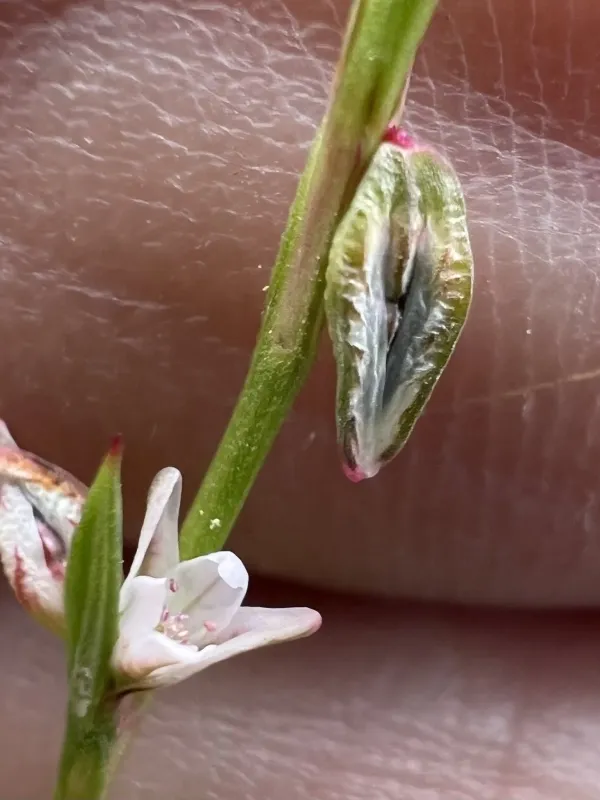
The plant typically exhibits an erect or spreading stem that branches from the base. The leaves are narrow and lance-shaped, arranged alternately along the stem.
Flowers are small and clustered in axillary inflorescences. The perianth usually displays a greenish or pinkish hue, which is common for species within this genus.
The root system is of a taproot type, allowing the plant to effectively anchor itself in various soil types, including rocky and dry environments.
The fruit is a three-sided achene that disperses easily via wind and water, ensuring rapid colonization of new areas during the growing season.
Where it grows
The primary distribution area for Douglas knotweed is North America. The plant prefers open habitats with moderate moisture levels.
It is frequently observed in pastures, along roadsides, in disturbed soil areas, and on the margins of agricultural crop fields.
The species demonstrates high adaptability to diverse soil and climatic conditions, allowing it to compete successfully with native vegetation.
In managed agricultural fields, Douglas knotweed appears as an opportunistic weed, quickly occupying vacant niches after soil cultivation.
The plant is particularly aggressive in areas with sparse vegetation, where competition from established crops or natural cover is minimal.
Harm it causes
The primary damage caused by Douglas knotweed involves competition with crops for essential mineral nutrients and soil moisture.
As an active colonizer, this weed reduces the overall productivity of pastures and forage lands by displacing valuable forage grasses.
The presence of this plant in agroecosystems complicates harvesting operations and can contribute to the contamination of crop seed stocks.
Under intensive farming conditions, high densities of Douglas knotweed lead to the suppression of crop seedling growth during early development.
Additionally, weeds of this family can act as reservoirs for various pests and plant pathogens that affect commercial field crops.
How to control
Mechanical cultivation, including deep plowing, is a fundamental method for controlling Douglas knotweed, as it disrupts root development and prevents flowering.
Timely mowing before the weed reaches the flowering and seed-set stage significantly reduces the long-term seed bank in the soil.
Chemical control involves the use of broad-spectrum herbicides during the active growth period when the weed is most susceptible to treatment.
Integrated pest management, including crop rotation and the use of cover crops, helps suppress weed development through canopy shading and competition.
- Regular field monitoring for weed patches.
- Application of post-emergence herbicides.
- Optimized seeding rates for crops.
- Thorough cleaning of agricultural machinery between fields.
Taxonomy
- Latin name
- Polygonum douglasii
- Family
- Гречишка вьюнковая
- EPPO code
- POLDO