
Dotted smartweed
Persicaria punctata
Description
How to tell it apart
Dotted smartweed (Persicaria punctata) is a member of the Polygonaceae family. It is a perennial herbaceous plant known for its aggressive growth habit and ability to colonize wet soils.
The plant is easily identified by the dark, glandular dots covering its leaves and stems, which give it a speckled appearance. Its stems are often ascending or trailing and tend to root at the nodes.
Its leaves are lanceolate, pointed at the apex, and feature characteristic thin, membrane-like sheaths known as ochreae at the base of the leaf stalks.
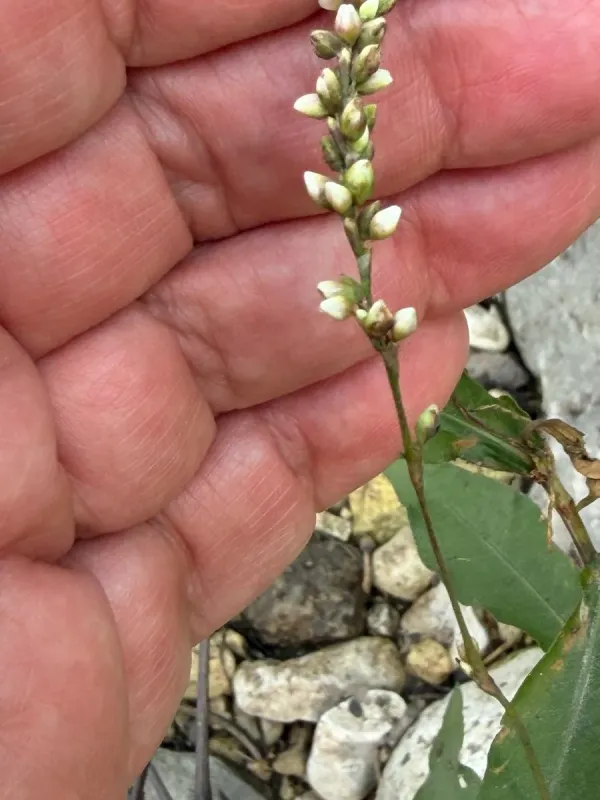
The inflorescence consists of loose, slender spikes with small, white or greenish-pink flowers. These blooms are typically inconspicuous compared to the plant's overall foliage.
The plant possesses an extensive rhizome system, which is the primary source of its tenacity. This underground structure allows it to survive harsh conditions and regenerate even after being cut.
Where it grows
Dotted smartweed thrives in moist to wet environments. It is commonly found in wetlands, drainage ditches, riverbanks, and low-lying areas of agricultural fields where water collects.
In farming, it is a significant pest in irrigated systems and fields with poor drainage. It quickly exploits saturated soil conditions that may inhibit other, less competitive weeds.
The weed is frequently observed in vegetable gardens and row crop production where frequent irrigation provides the constant moisture necessary for its rapid propagation.
It spreads efficiently through both seed dispersal—often moved by water currents—and vegetative fragments dispersed by farm equipment during soil cultivation.
Its presence is often a sign of excessive moisture in the soil, suggesting that site drainage improvement could be a primary preventative step for management.
Harm it causes
This weed causes significant yield reductions in agricultural crops by aggressively competing for water, sunlight, and essential nutrients like nitrogen and phosphorus.
During crop growth, dense patches of dotted smartweed can outcompete young seedlings, leading to reduced plant density and uneven crop stands in the field.
The presence of high biomass of this weed during harvest increases the moisture content of the grain, leading to higher post-harvest handling and drying costs.
Dotted smartweed acts as an alternative host for various agricultural pests and viral pathogens, creating a reservoir that facilitates their spread into nearby crop rows.
In addition to economic losses, the presence of its seeds or plant parts in harvest yields can downgrade the quality of agricultural products, potentially leading to market rejections.
How to control
Effective management begins with mechanical control, such as deep plowing, which disrupts the rhizome system and prevents the weed from re-establishing itself.
Improving the drainage capacity of fields is a highly effective long-term strategy, as it makes the environment less suitable for this moisture-loving perennial.
Chemical control usually involves the use of systemic herbicides. Applications are most effective during the rapid growth phase before the plant reaches the flowering stage.
Integration of crop rotation is essential, specifically selecting crops that form a dense canopy to shade out the weed and limit its access to sunlight.
- Frequent cultivation of rows to prevent rhizome expansion.
- Application of selective post-emergent herbicides according to label.
- Sanitation of equipment to prevent the spread of plant fragments between fields.
- Use of competitive cover crops during fallow periods.
- Targeted spot treatments in non-crop areas to prevent seed bank build-up.
Taxonomy
- Latin name
- Persicaria punctata
- Family
- Гречишка вьюнковая
- EPPO code
- POLPT