
Persicaria nepalensis
Persicaria nepalensis
Description
How to tell it apart
Persicaria nepalensis is a member of the Polygonaceae family. It is an annual herbaceous plant known for its creeping habit and rapid vegetative growth.
The stems can reach up to 60 cm in length, often branching at the base. These stems frequently root at the nodes when they come into contact with moist soil.
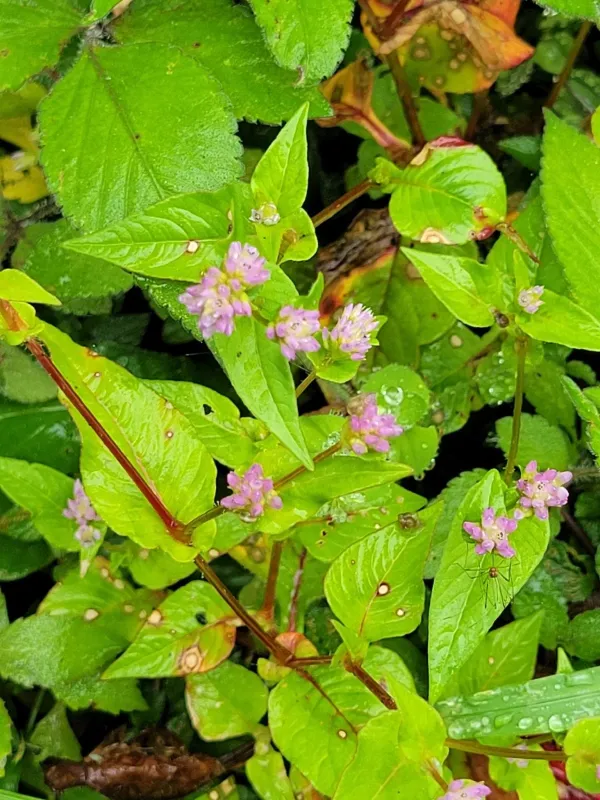
Leaves are distinctively triangular or ovate with a heart-shaped base and a pointed tip. A key diagnostic feature is the presence of winged petioles that sheath the stem.
Small flowers, ranging in color from pink to white, are clustered into compact, head-like inflorescences located at the terminals of the stems or in leaf axils.
The fruit is a small, dark brown or black achene, which is highly durable and serves as the primary mechanism for the plant's wide-scale dispersal.
Where it grows
This weed prefers moist and shaded environments, often colonizing stream banks, irrigation ditches, and damp areas within agricultural fields.
It is frequently observed as an invasive weed in row crops and vegetable gardens where moisture levels are consistently high throughout the growing season.
The plant adapts well to various soil types, provided that humidity levels are sufficient for its shallow, spreading root system to thrive.
Human activity is a major factor in its spread, as seeds are easily transported via contaminated machinery, muddy tools, and irrigation water flow.
It often acts as a pioneer species, quickly invading cleared land or areas where natural vegetation has been disturbed by intensive farming practices.
Harm it causes
The primary agricultural impact of Persicaria nepalensis is the severe competition with crops for essential soil moisture, nitrogen, and phosphorus.
Because it forms dense mats on the ground, it effectively outcompetes young seedlings for light, often resulting in stunted growth and significant yield loss.
The plant serves as a host for various agricultural pests and pathogens, which can easily migrate to neighboring healthy crops, complicating disease management.
Harvesting becomes significantly more difficult when infestations are present, as the weed can clog machinery and increase the moisture content of harvested grain.
With its ability to produce large quantities of seeds annually, it quickly builds up a persistent seed bank in the soil that can plague fields for many years.
How to control
Integrated weed management, starting with proper crop rotation, is essential to disrupt the life cycle of this annual weed in the affected field areas.
Mechanical cultivation remains a reliable method to manage populations, provided it is performed before the plants set their first seeds.
Chemical control involving selective post-emergence herbicides can be effective, provided that the application occurs when the weeds are in their early growth stages.
- Pre-emergence herbicide application to inhibit seed germination.
- Post-emergence spray treatments targeting the leaf rosette phase.
- Manual removal of patches near water sources to prevent further spread.
Monitoring field edges and maintaining clean drainage channels are vital preventive measures to keep the infestation levels manageable throughout the season.
Taxonomy
- Latin name
- Persicaria nepalensis
- Family
- Гречишка вьюнковая
- EPPO code
- POLNE