
Pale persicaria
Persicaria lapathifolia
Description
How to tell it apart
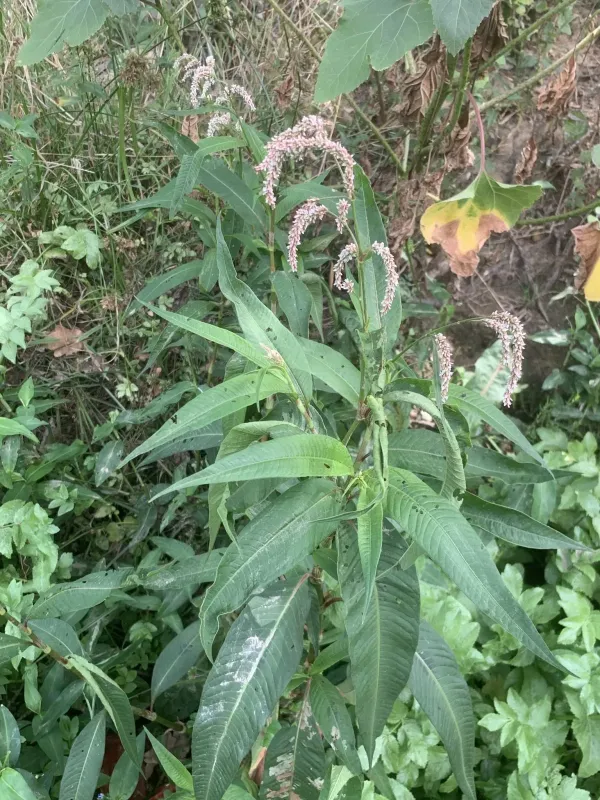
Pale persicaria (Persicaria lapathifolia) is an annual herbaceous weed belonging to the Polygonaceae family. It is characterized by its significant size and rapid growth rate under favorable conditions.
The stems are typically reddish, swollen at the nodes, and can grow up to 100 cm in height. The leaves are lanceolate, often featuring a distinct dark or black spot in the middle, which is a key identification mark.
The inflorescences are dense, spike-like racemes positioned at the tips of the stems. The flowers are usually pale green or pinkish, giving the plant its common English name.
The seeds are small, dark brown, and highly durable. A single plant can produce thousands of seeds that can survive in the soil seed bank for over a decade, making long-term control a challenge.
The weed is extremely adaptable. It thrives in various soil types but shows a clear preference for moist, nitrogen-rich substrates, often colonizing agricultural land very quickly.
Where it grows
This species is commonly found in damp areas, including riverbanks, ditches, and poorly drained fields. It is a frequent visitor to irrigated agricultural plots and valley bottoms.
It poses a major threat to crops such as maize, sunflowers, and cereals. It particularly thrives in fields where excess moisture allows it to outcompete standard crops for nutrients.
The weed often occupies open niches in fields after heavy rainfall, especially if the crop stand is not uniform or if canopy closure is delayed due to poor growing conditions.
It is widespread across temperate regions globally. Its ecological plasticity allows it to dominate in agricultural environments where the hydro-regime is unstable or frequently disturbed.
In addition to agricultural fields, it is frequently seen in waste areas and disturbed soils, acting as a pioneer species that quickly covers available ground with its abundant seed production.
Harm it causes
The primary damage caused by Pale persicaria is intense resource competition. It competes heavily for water, light, and soil nutrients, often starving the neighboring crop plants.
Heavy infestations lead to significant yield losses. In severe cases, the weed can dominate the field, resulting in crop failure if not managed during the early growth stages.
The presence of the weed hinders mechanical field operations. Large stems can clog equipment during inter-row cultivation, reducing the efficiency of field work and increasing maintenance costs.
It acts as an alternative host for various agricultural pests, including aphids. This facilitates the spread of viral and fungal diseases into the main crop, necessitating further chemical treatments.
Contamination of the harvested crop with weed seeds reduces the market value of the grain. It requires extra cleaning and processing efforts to meet quality standards for export or storage.
How to control
Effective management requires an integrated approach. Cultural practices such as crop rotation and balanced fertilization help the main crop gain a competitive advantage over the weeds.
Mechanical control through deep tillage and timely inter-row cultivation is essential for reducing the seed bank in the soil. Proper seedbed preparation is vital to trigger early weed emergence.
Chemical control is often the most effective method in large-scale farming. Herbicides should be applied when the weed is in the early seedling stage (2–4 true leaves) for optimal efficacy.
- Utilize crop rotation to break the weed life cycle.
- Ensure high-quality, weed-free seed sowing.
- Implement soil-applied herbicides to suppress germination.
- Apply post-emergence herbicides targeting the Polygonaceae family.
Monitoring field moisture levels is a key preventative measure. By improving field drainage, farmers can make the environment less favorable for the weed while simultaneously boosting crop health.
Taxonomy
- Latin name
- Persicaria lapathifolia
- Family
- Гречишка вьюнковая
- EPPO code
- POLLA