
Japanese knotweed
Persicaria japonica
Description
How to tell it apart
Japanese knotweed (Reynoutria japonica) is a tall, herbaceous perennial plant of the buckwheat family (Polygonaceae). It is characterized by its bamboo-like hollow stems and vigorous growth habit.
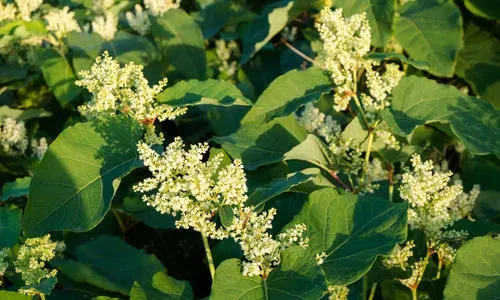
The leaves are broad, oval-shaped with a pointed tip, arranged alternately along the stem. The plant produces creamy-white flowers in dense panicles during late summer and autumn.
A key identifying feature is the deep, woody rhizome system which allows the plant to survive harsh winter conditions and regenerate rapidly during the growing season.
The stems often feature reddish-brown flecks or mottling, which distinguishes them from many native plant species. A single infestation can grow over two meters high within a few months.
Its ability to propagate from tiny stem or root fragments makes it one of the most resilient and difficult weeds to eradicate in modern agricultural settings.
Where it grows
This invasive weed thrives in various habitats, including riverbanks, roadsides, waste ground, and the margins of agricultural fields where soil moisture is abundant.
In farming areas, it often encroaches from fence lines and uncultivated edges into productive fields, posing a persistent threat to crop management and land value.
It prefers fertile soil but can adapt to a wide range of conditions, making it an extremely successful colonizer of disturbed land throughout the temperate regions.
Human activity, such as transporting soil or moving farm machinery, is the primary vector for the spread of knotweed fragments into new, unaffected areas.
Its adaptability allows it to dominate landscapes, outcompeting native vegetation and creating monocultures that are detrimental to local biodiversity.
Harm it causes
The primary agricultural impact of Japanese knotweed is the suppression of crops through shading. Its dense canopy prevents light from reaching the soil level, stifling crop development.
The extensive root system aggressively competes for water and nutrients, severely depleting soil resources that would otherwise support high-yield cash crops.
Beyond crop loss, its roots are strong enough to damage infrastructure, including irrigation pipes, drainage systems, and pavement, leading to significant repair costs for farmers.
Controlling this weed requires significant financial investment, increasing the cost of production and reducing the overall profitability of the affected land.
Because it is highly persistent, its presence significantly lowers the value of farmland, as it is considered one of the most difficult invasive species to clear.
How to control
Effective control requires an integrated approach, as mechanical cutting alone often stimulates further growth from the underground rhizome network.
Systemic herbicides, particularly those based on glyphosate, are the most recommended chemical control methods. These must be applied during the late growing season when the plant is translocating nutrients to its roots.
Mechanical removal involves deep excavation of the soil to ensure every single root fragment is removed, which is labor-intensive and expensive on a field scale.
Continuous monitoring and repeated treatments are essential for several years to ensure that any dormant rhizomes that begin to sprout are quickly addressed.
- Chemical treatment during late summer/early autumn.
- Exclusion zones to prevent spread by farm machinery.
- Deep soil cultivation combined with chemical follow-ups.
Taxonomy
- Latin name
- Persicaria japonica
- Family
- Гречишка вьюнковая
- EPPO code
- POLJA