
Persicaria decipiens
Persicaria decipiens
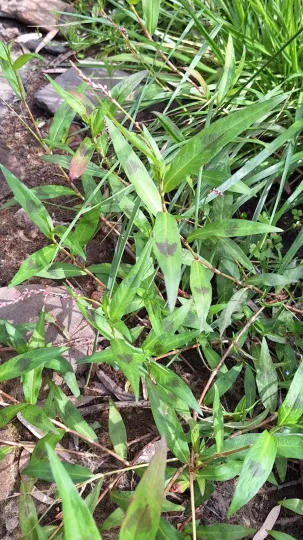
Description
How to tell it apart
Persicaria decipiens, belonging to the Polygonaceae family, is an annual herb often confused with Persicaria hydropiper due to its similar inflorescences and leaf structure.
The plant typically features ascending stems that branch from the base, reaching heights of 20 to 60 centimeters. Its leaves are lanceolate, sometimes exhibiting a distinctive dark blotch in the center, which serves as a key diagnostic trait.
Inflorescences consist of slender, spike-like racemes that are frequently interrupted. The tiny flowers are pink or white, giving the plant a characteristic appearance during its mid-summer to autumn flowering season.
The root system is fibrous and relatively shallow, allowing the plant to rapidly colonize moist soil environments. Reproduction occurs exclusively through seeds, which maintain viability in the soil for several years.
The seeds are triangular or lenticular in shape, appearing smooth and glossy. Due to the high seed production rate of individual plants, this weed can quickly occupy vacant areas in wetlands and agricultural fields.
Where it grows
This species favors moist habitats, often appearing in river floodplains, along water bodies, in drainage ditches, and in waterlogged areas of arable land.
In agricultural production, the weed poses a significant threat to fields with poor water management. It frequently affects row crops like corn or soybeans if water stagnation occurs within the plots.
The plant actively colonizes humid lowlands where the soil remains damp for extended periods following rainfall. This creates ideal conditions for its vigorous growth and competition with crops.
In paddy fields, Persicaria decipiens can act as a persistent weed, as it is perfectly adapted to conditions of excess moisture and periodic inundation.
It spreads primarily via seeds carried by water during irrigation or flooding, as well as through soil adhering to farm machinery during field operations.
Harm it causes
The primary harm involves intense competition with crops for nutrients, sunlight, and moisture during critical growth stages, which can severely limit yield potential.
High population densities of the weed in a field lead to significant yield losses, as it rapidly develops vegetative biomass that shades out young crop seedlings.
The presence of this weed complicates mechanized harvesting operations, as it clogs combine components and increases the moisture content of the harvested grain, necessitating additional drying costs.
As a host for various pathogens and pests, Persicaria decipiens indirectly contributes to the spread of diseases within agricultural crop stands.
Mass outbreaks reduce the quality of the commercial product through seed contamination, requiring complex and costly cleaning processes after the harvest is completed.
How to control
Agrotechnical management includes effective soil cultivation aimed at cutting root systems and destroying weed seedlings before the crop emerges.
Improving drainage on waterlogged plots is a crucial strategy, as it eliminates the environmental advantage the weed derives from high soil moisture levels.
Implementing a balanced crop rotation system, incorporating highly competitive crops, helps significantly reduce the population of Persicaria decipiens in affected fields.
Chemical control involves the application of soil-applied or post-emergence herbicides to which the species is susceptible. Glyphosate-based products are often used for pre-sowing field preparation.
Monitoring and managing weed populations in adjacent non-crop areas, such as ditch banks and field borders, is essential to prevent the re-introduction of seeds into cultivated fields.
Taxonomy
- Latin name
- Persicaria decipiens
- Family
- Гречишка вьюнковая
- EPPO code
- PRADE