
Chinese knotweed
Persicaria chinensis
Description
How to tell it apart
Chinese knotweed (Persicaria chinensis) is a perennial herbaceous plant belonging to the Polygonaceae family, widely recognized for its aggressive vegetative growth and root system.
The plant features creeping or ascending stems that readily root at the nodes, allowing it to form dense mats across fields and gardens, often choking out native vegetation.
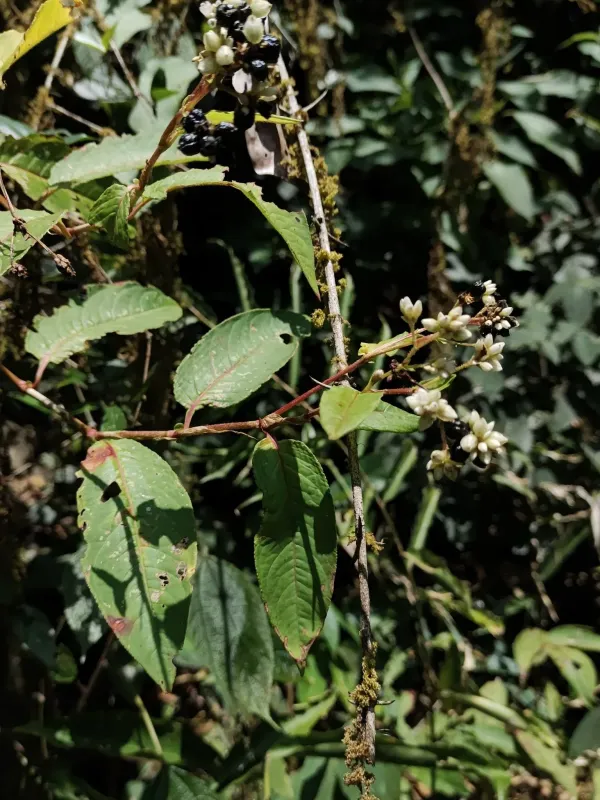
The leaves are typically ovate or lanceolate, often displaying a distinct dark marking or a V-shaped pattern on the leaf blade, which serves as a primary identification mark.
Inflorescences consist of small, dense spikes or heads, with flowers ranging in color from white to pink and purple, making them visually distinct during the blooming period.
Its root system is characterized by vigorous, branched rhizomes, which allow the plant to survive harsh environmental conditions and regenerate quickly even after being cut or damaged.
Where it grows
Persicaria chinensis primarily thrives in moist, subtropical environments, commonly found along riverbanks, irrigation ditches, rice paddies, and moist forest margins.
It prefers well-drained, nutrient-rich soils but shows remarkable adaptability, enabling it to colonize disturbed sites, plantations, and various types of agricultural land.
In agricultural settings, it is a significant nuisance for irrigation systems and orchards, where shade and high humidity provide ideal conditions for its rapid spread.
Seeds and root fragments are frequently dispersed by water, making it a persistent problem in areas connected to large irrigation or drainage networks.
It is often regarded as an invasive species in many regions, rapidly occupying open space in crop fields, nursery beds, and along rural transport routes.
Harm it causes
The main agricultural impact of Chinese knotweed is its fierce competition for light, water, and essential nutrients, which frequently results in reduced crop yields and stunted plant growth.
Its ability to form thick, impenetrable carpets prevents young seedlings of commercial crops from emerging and establishing, leading to significant stand thinning.
In rice cultivation, this weed disrupts field management and increases the competitive pressure on the crop, often necessitating increased fertilizer use to compensate for nutrient uptake by the weed.
The dense foliage creates an ideal microclimate for various crop diseases and pests, which can significantly increase the reliance on chemical control measures.
During harvest, infestations can cause significant logistical challenges, clogging harvesting equipment and lowering the quality of the harvested produce due to impurity contamination.
How to control
Effective management begins with mechanical interventions, such as deep tillage, which serves to disrupt the rhizomes and exhaust the plant’s energy reserves stored in the roots.
Crop rotation serves as a critical biological tool; alternating high-competition crops with cover crops can significantly suppress the weed's development and limit its expansion.
Chemical control focuses on the use of systemic herbicides applied to the foliage during the active growth phase, as these chemicals are translocated to the rhizomes to ensure complete destruction.
Selective herbicides must be chosen carefully to manage infestations within sensitive crop cycles, ensuring that the target weed is controlled without causing phytotoxic stress to the crop.
- Regular mowing or trimming before seed set to reduce the weed's reproductive success.
- Proper maintenance of irrigation channels to prevent the movement of weed propagules via water flow.
- Sanitation of equipment to prevent the transfer of root fragments between fields.
- Integration of cultural practices, such as mulching, to limit the light available for seedling emergence.
Taxonomy
- Latin name
- Persicaria chinensis
- Family
- Гречишка вьюнковая
- EPPO code
- POLCH