
Pink knotweed
Persicaria capitata
Description
How to tell it apart
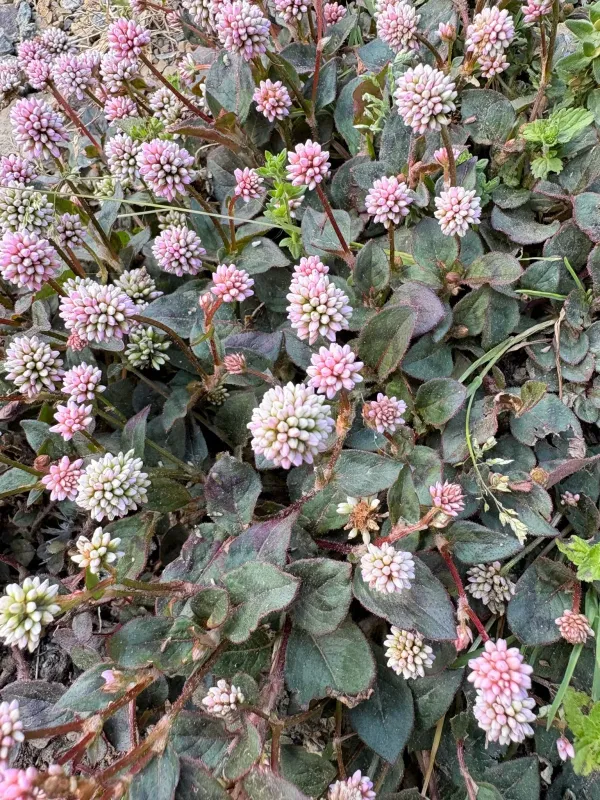
Pink knotweed belongs to the Polygonaceae family. It is a perennial herbaceous plant with creeping stems that root at the nodes, creating dense, mat-like carpets that cover the ground surface.
The leaves are typically ovate or elliptical in shape, often featuring a dark center spot or a characteristic V-shaped marking. It is easily identified by its small, globular inflorescences ranging in color from pink to white.
The root system is robust and aggressive, allowing the plant to colonize open spaces rapidly and outcompete cultivated plants by occupying both soil resources and space.
This weed exhibits high adaptability and propagates efficiently through vegetative parts. Small stem fragments containing a node can root upon contact with moist soil, establishing new colonies quickly.
The flowering and seeding cycle is prolonged, resulting in significant seed bank accumulation in the soil, which ensures the plant's long-term persistence in the agricultural environment.
Where it grows
Pink knotweed prefers moist, well-drained soils and is frequently found in disturbed habitats, along roadsides, field margins, and within ornamental or garden settings.
In agricultural settings, the weed is particularly aggressive in row crops, vegetable rotations, and irrigated fields, where moisture availability promotes its rapid growth and expansion.
It acts as a typical ruderal species, rapidly populating abandoned lands, ditch banks, and areas subject to high levels of human activity and mechanical disturbance.
Pink knotweed often spreads to arable fields from nearby landscaping or via soil and plant debris transported on machinery and agricultural equipment.
Its ability to tolerate partial shade makes it a persistent competitor in various settings, including young orchards where it can impede the development of woody saplings.
Harm it causes
The primary damage caused by Pink knotweed is its intense competition for water and nutrients, which significantly stunts the growth of crop plants during their most critical development stages.
The dense mats formed by the plant interfere with the root development of crops, reducing their resilience to drought and stress and leading to substantial yield losses.
As a reservoir for various pathogens and pests, Pink knotweed can complicate the phytosanitary status of a field, facilitating the spread of diseases to sensitive agricultural crops.
During harvest, the presence of actively growing knotweed can hinder machinery operation and increase the moisture content of the harvested crop, leading to higher post-harvest processing costs.
Contamination of harvested produce with knotweed seeds reduces market quality and creates a direct pathway for spreading the weed to previously uninfested areas.
How to control
Effective management of Pink knotweed requires an integrated approach that combines mechanical tillage practices with the targeted application of herbicides to protect crop yields.
Mechanical soil preparation, such as deep plowing with soil inversion, is beneficial for burying seeds deep enough to prevent emergence and for severing the root systems of established perennials.
Timely cultivation between crop rows is essential for row crops, as it allows for the destruction of weeds before they reach the flowering stage and begin seed production.
- Glyphosate-based herbicides are effective for clearing fallow land or preparing seedbeds before crop planting.
- Selective herbicides are used within standing crops to suppress broad-leaved weeds without damaging the primary culture.
- Implementing a well-planned crop rotation strategy helps to break the life cycle of the weed and reduce soil seed bank levels.
Regular monitoring of fields allows for the early detection and spot-treatment of emerging patches, which prevents widespread infestation and optimizes the overall cost of weed control programs.
Taxonomy
- Latin name
- Persicaria capitata
- Family
- Гречишка вьюнковая
- EPPO code
- POLCT