
Persicaria acuminata
Persicaria acuminata
Description
How to tell it apart
Persicaria acuminata is a perennial herbaceous plant belonging to the Polygonaceae family, characterized by a robust and spreading root system.
The stems can grow tall, appearing erect or ascending, and often feature branching patterns that contribute to the plant's ability to cover large surface areas.
The leaves are distinctly lanceolate and acuminate (tapered to a long point), with visible venation and occasionally fine hairs on the surface.
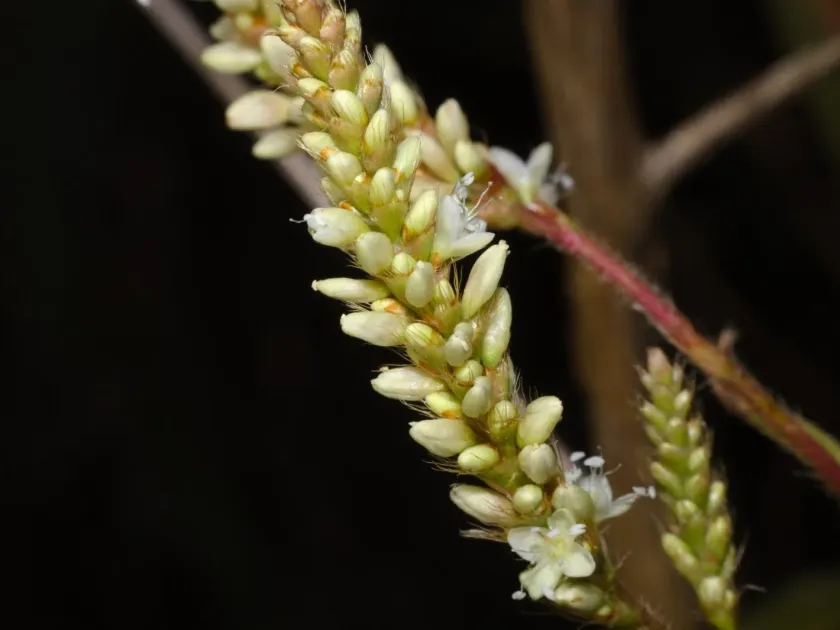
Flowers form in dense, spike-like terminal racemes, typically displaying white or pale pink colors that emerge during the active growth period.
A diagnostic feature of this species is the presence of the ochrea, a membranous sheath wrapping around the stem at the base of the leaf nodes.
Where it grows
This weed is highly adapted to wet environments, commonly thriving along riverbanks, in marshes, and on poorly drained agricultural land.
In agricultural settings, it is frequently found in irrigated crop fields, paddy fields, and areas prone to seasonal flooding or waterlogging.
The plant demonstrates high ecological plasticity, allowing it to colonize disturbed sites where moisture is consistently available for growth.
It is widespread across tropical and subtropical zones, where the lack of frost allows for continuous vegetative growth and rapid spread.
Water systems often act as the primary vector for the dispersal of seeds and rhizome fragments into new fields and production areas.
Harm it causes
As an aggressive competitor, Persicaria acuminata effectively outcompetes crops for essential nutrients, water, and sunlight, leading to significant yield losses.
The dense foliage creates a canopy that restricts air circulation and increases humidity, which can promote the growth of various plant pathogens.
Its deep and extensive root system depletes soil fertility rapidly, requiring higher inputs of fertilizers to maintain crop productivity.
The presence of this weed interferes with mechanical harvesting operations, potentially damaging machinery and reducing the efficiency of field work.
Contamination of harvested grain with vegetative parts of the weed increases processing costs and lowers the overall market value of the crop.
How to control
Cultural control methods such as deep tillage are essential to break up the extensive root systems and prevent the plant from establishing dense colonies.
Managing soil moisture through improved drainage systems can make the environment less hospitable for this moisture-loving weed.
Chemical control involving systemic herbicides is the most effective approach for managing mature plants, especially during active growth stages.
Integrated weed management should include crop rotation strategies to minimize the persistence of the seed bank in the soil over several seasons.
- Regular mechanical cultivation to suppress regrowth of rhizomes.
- Scouting for early outbreaks near water sources or field margins.
- Application of selective herbicides based on specific crop-weed competition timing.
Taxonomy
- Latin name
- Persicaria acuminata
- Family
- Гречишка вьюнковая
- EPPO code
- POLAN