
Weyrich's knotweed
Koenigia weyrichii
Description
How to tell it apart
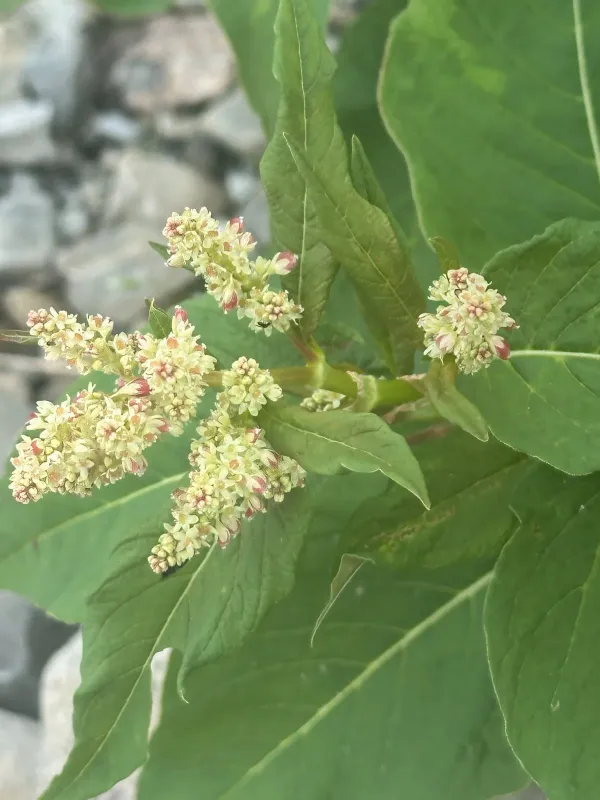
Weyrich's knotweed (Koenigia weyrichii) is a large, hardy perennial herbaceous plant belonging to the Polygonaceae family.
The plant features broad, ovate leaves with heart-shaped bases and a distinctively hairy texture on the underside of the leaf blades.
Its stalks are upright and robust, often becoming woody at the base, which allows the plant to reach heights of two meters or more.
During late summer, the plant produces dense panicles of small white or cream-colored flowers that are highly visible in the field.
The underground structure is characterized by a vigorous network of rhizomes, which are responsible for its rapid expansion and persistence.
Where it grows
Native to the Russian Far East, the species typically occupies moist meadows, riverbanks, and slopes with high moisture availability.
In agricultural settings, it commonly infests field margins, irrigation ditches, and uncultivated lands near natural wild populations.
The weed demonstrates a wide ecological tolerance, allowing it to colonize diverse soil types including compacted or nutrient-poor soils.
Once established in a field, the plant quickly encroaches upon cultivated areas, particularly in low-lying or poorly drained sections of the plot.
Human activity, such as tillage and machinery movement, often aids the distribution of plant fragments, leading to localized patches of infestation.
Harm it causes
Weyrich's knotweed competes aggressively with crops for essential resources like light, water, and soil nutrients, significantly reducing yield potential.
The dense foliage canopy creates substantial shade, which suppresses the growth of neighboring crop seedlings during the critical early growth phases.
Its extensive root system causes significant soil water depletion, exacerbating drought stress for primary crops in drier growing seasons.
The physical presence of the plant hinders the operation of harvesting machinery, leading to increased maintenance costs and potential harvest delays.
It acts as a host for various agricultural pests and pathogens, serving as a reservoir that sustains infestations throughout the crop rotation cycle.
How to control
Effective control strategies require a combination of cultural practices, primarily deep plowing to expose and desiccate the extensive rhizome system.
Regular mechanical tillage or disking during the growing season helps to deplete the food reserves stored within the plant's roots.
Chemical control is most effective when systemic herbicides (e.g., glyphosate-based) are applied during the post-harvest period on actively growing foliage.
Selective herbicides may be utilized during the crop growing season to manage younger weeds and prevent them from reaching maturity.
- Implement deep autumn plowing.
- Ensure field margin sanitation.
- Use systemic herbicides for rhizome destruction.
- Incorporate crop rotation to suppress establishment.
Taxonomy
- Latin name
- Koenigia weyrichii
- Family
- Гречишные
- EPPO code
- POLWE