
Pectis papposa
Pectis papposa
Description
How to tell it apart
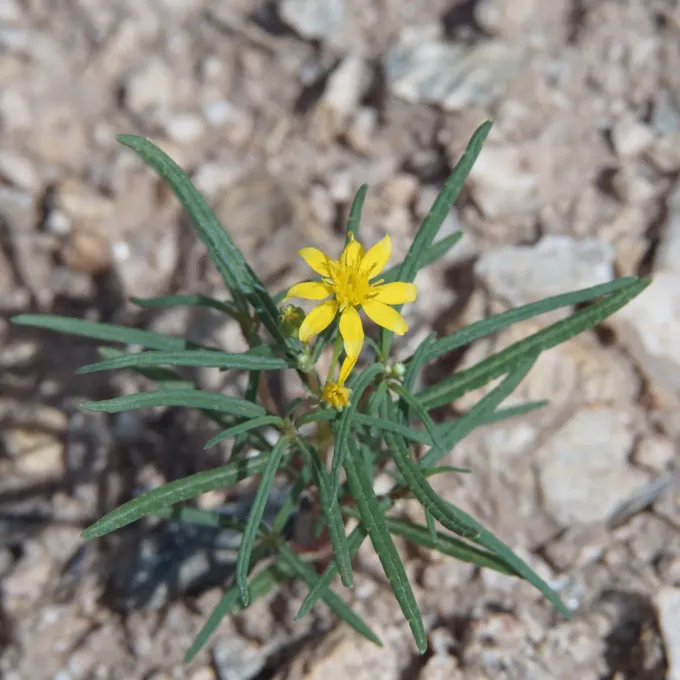
Pectis papposa is an annual herbaceous plant belonging to the Asteraceae family. It is a low-growing species that typically reaches heights of 5 to 20 centimeters.
The plant is distinguished by a strong, lemon-like scent, caused by numerous glandular dots present on the leaves and stems.
Its leaves are linear and narrow, often characterized by ciliate margins, which gives the plant a distinct appearance in the field.
The flowers are arranged in small heads. After blooming, the plant produces seeds equipped with a feathery pappus, facilitating wind dispersal over wide areas.
It features a robust taproot system that provides the plant with the ability to extract deep soil moisture, making it highly resilient in desert-like conditions.
Where it grows
This weed is primarily found in arid and semi-arid regions, particularly across the southwestern United States and northern Mexico.
It favors open, disturbed habitats such as desert plains, sandy soils, and roadsides where competition from perennial vegetation is minimal.
In agricultural settings, it frequently infests irrigated fields, including melon and vegetable crops grown in desert valleys.
The plant effectively colonizes field margins and irrigation ditches, using these areas as corridors to spread into cultivated plots.
Pectis papposa is notably salt-tolerant, allowing it to persist in saline soil conditions where other plant species may struggle to establish.
Harm it causes
The primary damage caused by this weed is the intense competition for water, which is a limiting factor in arid agricultural ecosystems.
Its ability to form dense stands can suppress crop emergence, significantly reducing plant density during the critical early stages of crop development.
The plant may exhibit allelopathic effects due to its volatile oils, which can negatively interfere with the growth and development of adjacent crops.
Contamination of harvested products with Pectis papposa seeds increases the cost of post-harvest cleaning and lowers the overall market quality of the yield.
Large populations of the weed interfere with mechanical farm operations, requiring additional labor and costs for cultivation and management.
How to control
A primary agronomic strategy includes deep plowing during the germination period to eliminate young seedlings before they compete with the crop.
Maintaining optimal crop spacing and canopy density helps shade the ground, which effectively restricts the development of this light-loving weed.
Chemical control involving pre-emergent or post-emergent herbicides is essential when managing heavy infestations in specialized crop systems.
Preventive measures, such as cleaning agricultural machinery and managing field borders, are critical to stop the spread of wind-dispersed seeds.
- Implement strict crop rotation schemes to break the life cycle.
- Mechanical weeding of inter-row spaces during the growing season.
- Use of registered chemical herbicides at recommended application rates.
Taxonomy
- Latin name
- Pectis papposa
- Family
- Сложноцветные (астровые)
- EPPO code
- PCSPA