
Packera werneriifolia
Packera werneriifolia
Description
How to tell it apart
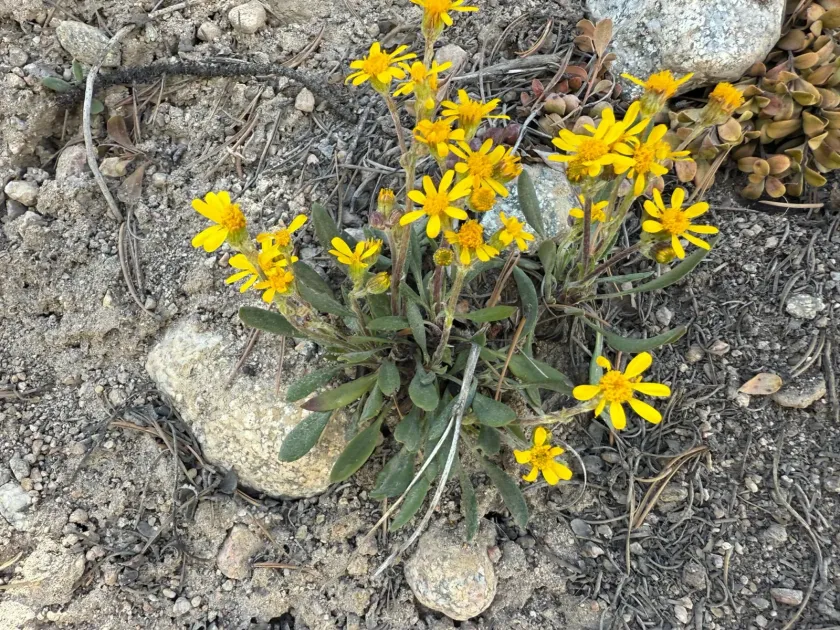
Packera werneriifolia is a perennial herbaceous plant belonging to the Asteraceae family, typically characterized by a low, mat-forming growth habit.
The leaves are predominantly basal, arranged in a rosette, and feature a dense covering of fine hairs that aid in moisture retention in dry habitats.
During the flowering season, the plant produces distinctive yellow daisy-like flower heads on short, sturdy stems, making it easily recognizable in fields.
It possesses a strong, deep-reaching taproot system that allows the plant to access moisture in rocky or impoverished soil conditions where others might fail.
The reproductive strategy includes both vegetative propagation through root fragments and sexual reproduction via wind-dispersed seeds equipped with pappus.
Where it grows
The native habitat of this species includes mountainous regions, stony slopes, and open alpine meadows, where it thrives in well-drained, nutrient-poor substrates.
In agricultural settings, it occasionally invades adjacent pastures, field borders, and roadside areas, taking advantage of soil disturbance to establish new colonies.
It prefers areas with high sunlight exposure and generally avoids zones with high moisture accumulation or competition from tall, densely growing crops.
Packera werneriifolia is highly adaptable to disturbed ground, meaning it can quickly colonize fallow land or neglected crop fields if left unmanaged.
It is often found in sites with rocky, gritty, or skeletal soils, displaying a high tolerance for environmental stress typical of mountainous agriculture.
Harm it causes
The primary agricultural impact of this weed is its ability to compete aggressively for soil moisture and nutrients during the critical crop establishment phase.
As a member of the Asteraceae family, it may serve as an alternative host for various crop pathogens, including viral and fungal diseases that affect field crops.
In livestock grazing systems, the plant is potentially toxic, containing alkaloids that can cause poisoning symptoms in ruminants that ingest it in significant amounts.
The presence of dense clusters of the plant can impede farm machinery operations, increase wear on implements, and lead to reduced harvest quality.
It exerts an allelopathic influence on the surrounding microenvironment, inhibiting the growth and nutrient uptake of nearby beneficial plants and crop species.
How to control
Mechanical control through deep primary tillage is highly effective, as it exposes the deep taproots to desiccation and destroys the perennial root structure.
Integrating a well-planned crop rotation program that includes competitive, dense-canopy crops can significantly shade out and suppress the weed's development.
Chemical control can be achieved using systemic herbicides, specifically targeting the plant during the active growth phase when nutrient translocation is highest.
Selective post-emergence herbicides, particularly those mimicking plant growth hormones, have shown success in managing populations within established crop stands.
- Frequent monitoring to detect early infestation spots.
- Timely cultivation to disrupt root development.
- Application of targeted systemic herbicide programs.
Taxonomy
- Latin name
- Packera werneriifolia
- Family
- Сложноцветные (астровые)
- EPPO code
- PKRWE