
Climbing hempvine
Mikania scandens
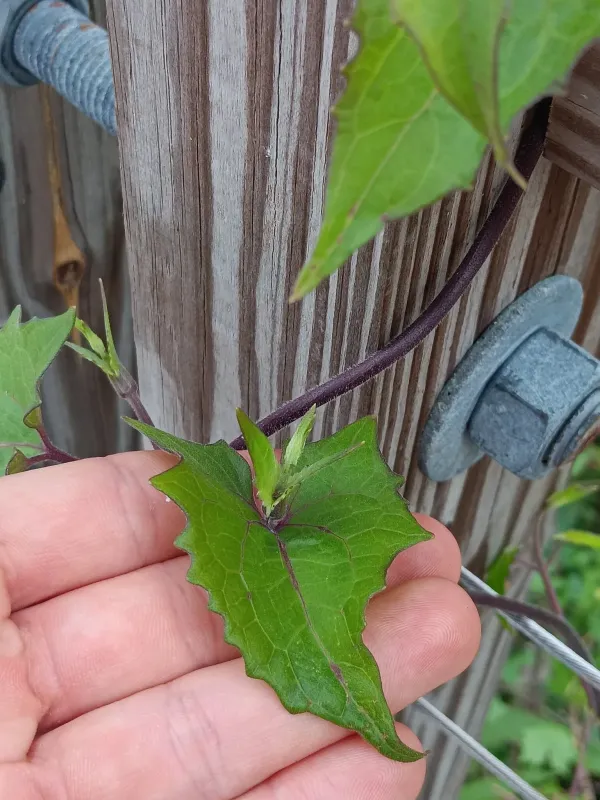
Description
How to tell it apart
Climbing hempvine (Mikania scandens) is a perennial, twining herbaceous vine belonging to the Asteraceae family. It is characterized by its slender, flexible stems that readily climb on surrounding vegetation and structures.
The leaves are opposite, heart-shaped, and usually feature a pointed apex with a slightly serrated or entire margin. The distinct leaf venation is a key trait for field recognition by scouts.
The inflorescences are composed of small, fragrant, white to pinkish flower heads arranged in dense corymbs. These blooms are highly attractive to pollinators, facilitating the production of large seed quantities.
Its root system is fibrous and aggressive, often forming dense mats that store carbohydrates, enabling the plant to regenerate vigorously even after mechanical damage.
The plant is highly adaptable and can thrive in diverse environments, from wetlands and riparian zones to agricultural settings, provided there is enough light for initial establishment.
Where it grows
The species is native to North and South America, widely distributed across subtropical and tropical climates. It is frequently found in moist habitats, including forest edges, stream banks, and marshes.
In agriculture, it is a significant pest in plantation crops such as sugarcane, cocoa, and various fruit orchards. Its climbing nature allows it to quickly overwhelm young trees and shrubs.
It often colonizes disturbed areas like roadsides, fence lines, and irrigation ditches, using these corridors to spread its wind-dispersed seeds across larger regions.
The weed exhibits rapid growth rates, allowing it to smother existing vegetation within a single growing season if left unchecked.
In warmer climates, it grows throughout the year, maintaining green cover and continuously outcompeting other species for limited ecological resources.
Harm it causes
The primary harm caused by climbing hempvine is the physical strangulation and overtopping of crop plants. By climbing over them, the weed creates dense canopies that intercept vital sunlight.
The plant acts as a heavy competitor for soil moisture and nutrients, which often leads to stunted growth and reduced yields in commercial plantations and field crops.
Harvesting efficiency is significantly reduced due to the tangled vine mass, which interferes with agricultural machinery, causes equipment clogging, and increases operational downtime.
It can act as a reservoir host for various viral diseases and pests, which can be transmitted to crops, thereby complicating integrated pest management strategies.
- Significant reduction in crop photosynthesis.
- Mechanical interference with harvesting equipment.
- Increased production costs due to constant weed maintenance.
How to control
Mechanical control is effective in the early stages; frequent mowing or manual uprooting of the entire root system prevents the vine from gaining the necessary energy to survive.
Deep cultivation of the soil is recommended to destroy the underground rhizomes, although care must be taken to ensure no plant segments remain in the soil to propagate.
Chemical control involving systemic herbicides applied during the rapid growth phase is often necessary to achieve deep penetration into the roots and ensure long-term eradication.
Strict monitoring and quarantine practices are essential to prevent the introduction of this weed into new agricultural areas, especially when transferring machinery or seed batches.
Integrated management involving competitive cover crops can also help suppress the establishment of climbing hempvine by limiting its access to space and sunlight.
Taxonomy
- Latin name
- Mikania scandens
- Family
- Сложноцветные (астровые)
- EPPO code
- MIKSC