
Mikania
Mikania
Description
How to tell it apart
Mikania is a genus of climbing vines belonging to the Asteraceae family. Known for its rapid growth, it is often referred to as a "mile-a-minute" weed due to its ability to spread aggressively over large areas in a very short time.
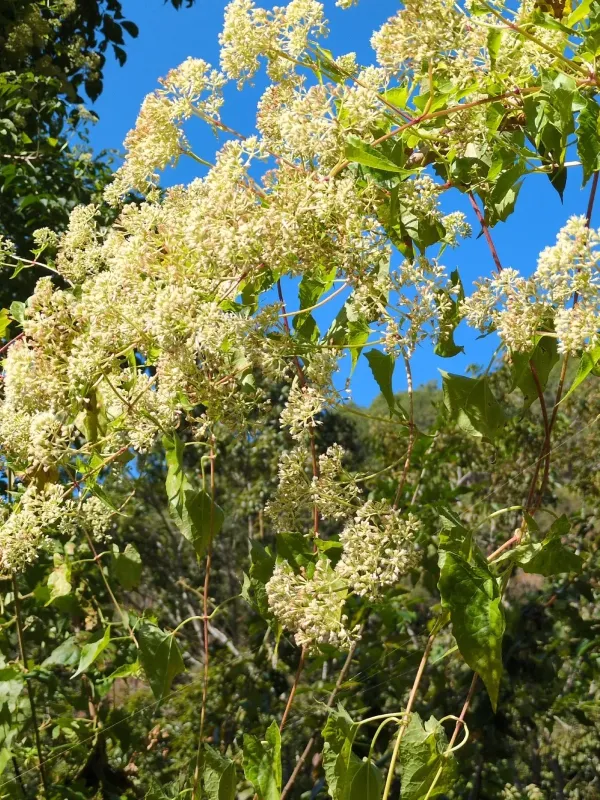
The leaves are typically opposite, heart-shaped, and possess dentate margins. The vine structure is lightweight but durable, allowing it to scramble over other plants, fences, and structures using its twining habit.
Its inflorescences consist of small, white or greenish-white flower heads arranged in dense terminal or axillary panicles. These flowers are highly productive in terms of seed generation, facilitating rapid colonisation.
Stems of Mikania are often smooth or slightly hairy and can reach significant lengths. A key identification feature is the ability of the nodes along the stem to develop adventitious roots when they come into contact with moist soil.
The root system is fibrous and tenacious, making it difficult to pull the plant out completely by hand. Every node buried in the soil acts as a potential point for new shoot development, complicating physical removal efforts.
Where it grows
Mikania is native to tropical regions and thrives in warm, humid climates. It prefers sunny or partially shaded environments and is commonly found in disturbed areas, forest edges, and along riverbanks.
In agricultural settings, it is a significant pest in plantation crops such as tea, coffee, oil palm, and cocoa. It exploits the space between rows and eventually overtakes the crop canopy.
It adapts well to various soil types, provided there is adequate moisture. It is particularly invasive in areas with high rainfall, where the lack of a distinct dry season allows for continuous vegetative growth throughout the year.
The weed colonises abandoned fields, fallow lands, and roadsides, using these as secondary habitats to launch invasions into nearby high-value cropping areas.
Human activity, including the movement of contaminated soil or machinery, is a primary factor in the long-distance dispersal of Mikania seeds and stem fragments.
Harm it causes
The primary damage caused by Mikania is through light competition. As a climbing vine, it forms a dense mat over the crop canopy, effectively shading out the host plant and inhibiting its ability to perform photosynthesis.
Severe infestations lead to a significant drop in crop yields, stunted growth, and, in cases of young saplings, the death of the plant due to complete light deprivation and mechanical strangulation.
Mikania also competes aggressively for water and essential soil nutrients. Its extensive root network can deplete the soil profile, leaving the primary crop in a state of nutrient deficiency.
The weed acts as a secondary host for various plant viruses and pests. By harbouring these pathogens, it increases the disease pressure on the surrounding plantation, complicating pest management programs.
Operational costs rise significantly in infested areas, as the dense vines hinder irrigation maintenance, manual harvesting, and the application of fertilizers to the target crops.
How to control
Controlling Mikania requires an integrated approach starting with manual labour. Regular manual weeding is essential, but it must include the removal of all stem fragments to prevent regrowth.
Good agricultural practices such as maintaining cover crops or clean inter-row management help suppress the establishment of new Mikania seedlings. Frequent cultivation is effective during the early stages of infestation.
Chemical control involving systemic herbicides is widely used in commercial plantations. Glyphosate-based products are often the standard, applied as targeted spot-sprays to minimize impact on the main crop.
It is crucial to time herbicide applications correctly, focusing on the vegetative phase before the plant begins to flower, which reduces the seed bank for the following season.
- Regular slashing of climbing vines.
- Physical removal of roots to prevent vegetative spread.
- Spot application of systemic herbicides.
- Use of mulching to prevent seed germination.
Taxonomy
- Latin name
- Mikania
- Family
- Сложноцветные (астровые)
- EPPO code
- MIKSS