
Pineappleweed
Matricaria discoidea
Description
How to tell it apart
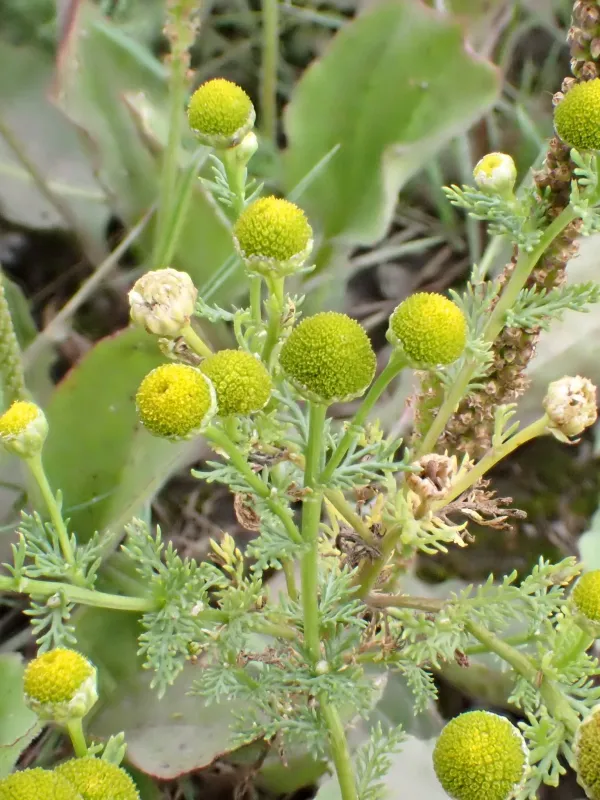
Pineappleweed is an annual herbaceous plant belonging to the Asteraceae family. Its most notable feature is the absence of white ray florets, resulting in conical, yellowish-green flower heads.
The plant gets its common name from the strong, pineapple-like scent released when the foliage or flower heads are crushed or brushed against in the field.
The stems are erect, highly branched, and hairless, typically growing between 10 to 30 centimeters tall. The leaves are finely dissected into narrow, thread-like segments.
Flowering occurs from May through October. Each plant produces a vast number of small, elongated achenes that are easily dispersed by wind, water, and agricultural machinery.
It possesses a shallow taproot system, which allows it to thrive in compacted soils but also makes the plant relatively easy to remove through mechanical cultivation.
Where it grows
This weed is commonly found in disturbed areas, including roadsides, footpaths, driveways, and waste grounds. In agricultural settings, it frequently invades crop fields.
Pineappleweed is highly adaptable to various soil types, ranging from sandy and gravelly soils to heavy clay, often appearing where the soil has been recently disturbed.
It is a classic ruderal species that quickly colonizes empty spaces after tillage or cultivation, competing for space with emerging crop seedlings in early spring.
The plant thrives in compacted soil conditions where other species may struggle, making it a persistent issue in heavily trafficked parts of farm operations.
Its ability to produce a massive seed bank ensures that the population can persist in a field for years, even if the current vegetation is successfully suppressed.
Harm it causes
The primary damage caused by pineappleweed is its competition with crops for limited water, sunlight, and soil nutrients, leading to reduced overall yield and quality.
In dense infestations, the weed creates a thick cover that traps moisture near the soil surface, promoting the development of fungal diseases and root rot in crops.
The presence of pineappleweed interferes with harvesting operations, as the high water content of the green biomass increases the moisture level of grain shipments.
In pastures, it is generally unpalatable to livestock due to its strong odor, effectively reducing the available forage area and the overall nutritional value of the hay.
Seed contamination is a significant issue, as the small seeds of pineappleweed are difficult to separate from many crop seeds, reducing the market value of the harvest.
How to control
Effective management begins with proper crop rotation and the use of competitive crop varieties that can shade out emerging weed seedlings early in the season.
Mechanical control, such as shallow cultivation or hoeing, is very effective for removing young plants before they reach the flowering stage and produce seeds.
Chemical control involving selective herbicides is a standard practice in commercial agriculture, targeted at the early rosette growth stage for optimal absorption.
- Mowing roadsides and field margins to prevent seed spread.
- Using high-quality, certified seed free of weed contamination.
- Timely harrowing or inter-row cultivation during the growing season.
For chemical programs, herbicide rotation is essential to prevent the development of resistant weed populations, especially in areas with frequent past applications.
Taxonomy
- Latin name
- Matricaria discoidea
- Family
- Сложноцветные (астровые)
- EPPO code
- MATMT