
Chile tarweed
Madia sativa
Description
How to tell it apart
Chile tarweed (Madia sativa) is an annual herbaceous plant belonging to the Asteraceae family, typically reaching a height of 30 to 100 cm.
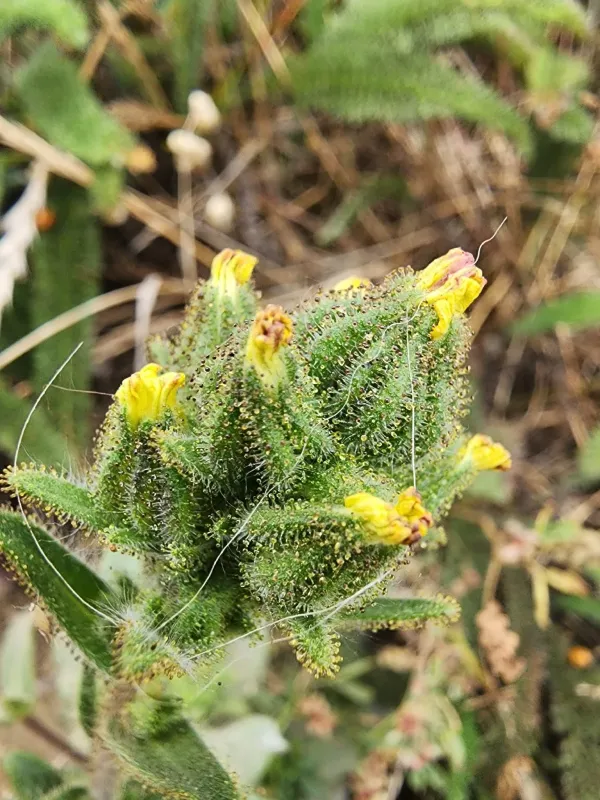
The stem is upright, branched, and densely covered with glandular hairs, which give the plant its characteristic sticky texture.
The leaves are alternate, linear-lanceolate in shape, with entire or slightly toothed edges. Its foliage often exudes a pungent, resinous odor.
Flower heads are small, gathered in a loose panicle. Ray florets are yellow, often inconspicuous, while disk florets are yellowish or brownish.
The achenes (seeds) are obovate and compressed, black or dark gray. It reproduces exclusively by seeds, which remain viable in the soil for several years.
Where it grows
Chile tarweed is an introduced species that frequently infests cereal fields, row crops, and uncultivated lands.
The weed actively colonizes roadsides, abandoned farmlands, and waste areas, where seeds are easily dispersed by wind or agricultural machinery.
It causes the most significant damage to spring crops, where its rapid growth and branched stem allow it to compete successfully for light and nutrients.
The plant adapts well to various soil types, including loams and chernozems, but generally avoids waterlogged areas.
In intensive farming systems, Chile tarweed can form dense patches that crowd out crop plants during the early stages of development.
Harm it causes
The primary danger of this weed lies in its high competitive capacity. The sticky glandular hairs and aggressive growth allow it to suppress the development of crop seedlings effectively.
The weed absorbs substantial amounts of water and minerals from the soil, leading to significant yield losses in cereal and industrial crops.
The presence of tarweed in crops complicates mechanical harvesting. The sticky stems often clog the moving parts and mechanisms of combine harvesters.
Seeds have high viability and frequently contaminate harvested grain, reducing its quality and requiring extra costs for cleaning and processing.
Furthermore, the plant can act as a reservoir for various pathogens and pests that may subsequently migrate to cultivated crops.
How to control
Agrotechnical control includes strict adherence to crop rotation. Leaving fields fallow without weed management is unacceptable to prevent flowering and seed dispersal.
Effective methods include high-quality primary soil tillage, such as deep plowing, which buries seeds at a depth that prevents germination.
During the vegetation period, timely harrowing of seedlings and inter-row cultivation in row crops are crucial for keeping the infestation under control.
Chemical control involves the use of systemic herbicides. Products from the 2,4-D, sulfonylurea, and imidazolinone groups have proven most effective.
- Timely cleaning of seed stocks.
- Application of selective herbicides during early growth phases.
- Monitoring the cleanliness of field borders and adjacent uncultivated areas.
- Early harvest to prevent seed shedding and soil re-contamination.
Taxonomy
- Latin name
- Madia sativa
- Family
- Сложноцветные (астровые)
- EPPO code
- MADSA