
Madia glomerata
Madia glomerata
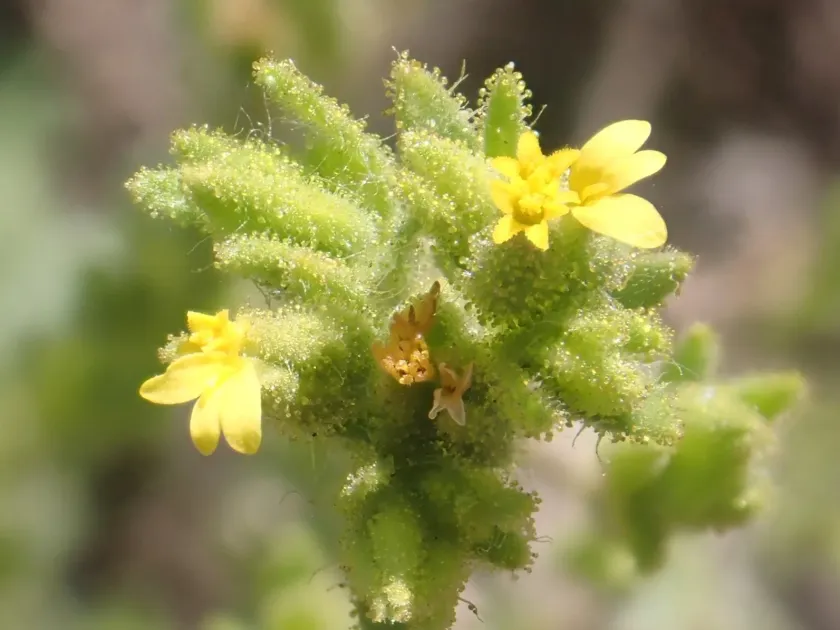
Description
How to tell it apart
Madia glomerata, commonly known as mountain tarweed or sticky tarweed, is an annual herbaceous plant belonging to the Asteraceae family.
The plant is easily identified by its sticky, glandular hairs that cover the stems and leaves, releasing a distinct resinous odor.
It grows as a single, erect stem reaching heights between 10 and 60 centimeters, typically branching at the upper part of the plant.
The leaves are narrow and lance-shaped, arranged alternately along the stem, often becoming shorter and more compact towards the top.
The yellow flowers are arranged in small, crowded clusters at the tips of the branches, giving the plant its specific name meaning gathered or clustered.
Where it grows
This weed thrives in open, sunny locations with dry to moderately moist soils, often found in pastures, roadsides, and disturbed ground.
In agricultural settings, it frequently infests cereal crops, forage crops, and fallow fields where soil management has been inconsistent.
Its high ecological adaptability allows it to colonize diverse landscapes, making it a common sight across various climate zones in North America.
Seeds are dispersed effectively by wind and water, and often travel long distances, allowing the plant to spread into new field areas rapidly.
It prefers disturbed soils where it can outcompete native vegetation and struggle against crop plants for essential environmental resources.
Harm it causes
The primary harm caused by Madia glomerata is intense competition with crops for soil moisture, nutrients, and sunlight, leading to reduced overall yield.
The sticky nature of the plant causes significant mechanical difficulties during harvest, as it clings to machinery and clogs harvesting equipment.
Presence of the weed leads to contamination of the harvested grain, which requires expensive post-harvest cleaning and processing to reach market standards.
It can act as a secondary host for various plant pathogens and pests, which can significantly damage the health of the primary crop.
Large populations of this weed can dominate an area, suppressing the growth of desired vegetation and requiring intensive land rehabilitation efforts.
How to control
Effective control requires an integrated approach starting with proper cultural practices such as crop rotation and timely soil tillage.
Mechanical removal is most effective when performed before the plant sets seeds, as the seed bank can persist in the soil for several seasons.
Chemical control can be achieved using selective herbicides during the early stages of plant growth, ensuring proper dosage and timing.
- Utilizing weed-free certified seeds to prevent introduction.
- Strategic mowing of field borders and adjacent areas to stop seed dispersal.
- Application of systemic herbicides tailored to specific crop safety requirements.
Monitoring fields early in the season and targeting the weed before it matures is the most cost-effective method to maintain field productivity.
Taxonomy
- Latin name
- Madia glomerata
- Family
- Сложноцветные (астровые)
- EPPO code
- MADGL