
Oxeye daisy
Leucanthemum vulgare
Description
How to tell it apart
Oxeye daisy, scientifically known as Leucanthemum vulgare, is a perennial flowering plant belonging to the Asteraceae family. It typically grows to a height of 30 to 80 centimeters, featuring a single, sturdy, and slightly branched stem.
The root system is composed of short, creeping rhizomes and a fibrous root structure that allows the plant to persist in the soil throughout the winter months and sprout early in the spring.
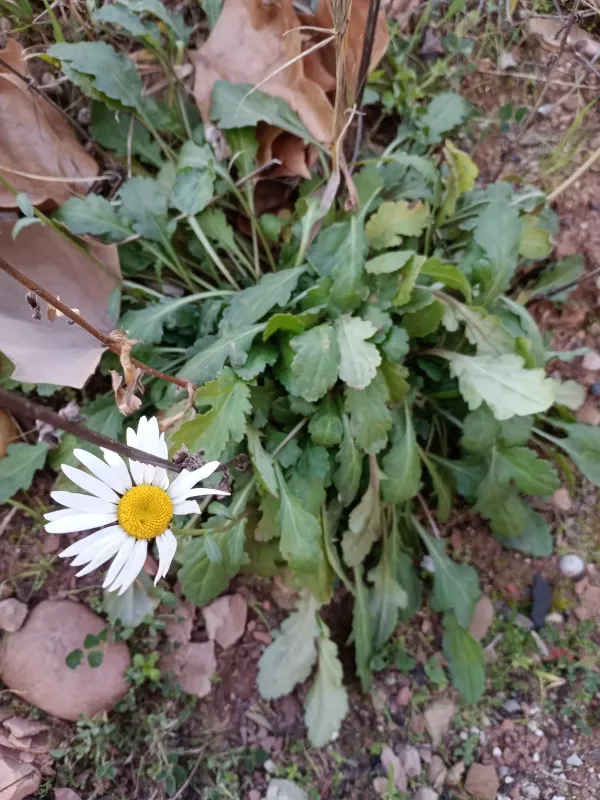
Its leaves are distinct: basal leaves are spoon-shaped with long petioles, while stem leaves are smaller, sessile, and coarsely toothed along the edges, growing alternately along the stem.
The plant produces characteristic inflorescences known as flower heads, consisting of white ray florets surrounding a dense, bright yellow disc of central tubular florets.
The seeds are small, dark, and ribbed, which allows them to be easily dispersed by wind, water, or agricultural machinery, leading to the rapid colonization of open areas.
Where it grows
Leucanthemum vulgare is widely adapted to various environments, commonly found in meadows, pastures, roadsides, and disturbed areas across temperate climatic zones.
As a field weed, it thrives in damp, nutrient-rich soils and often invades perennial grass stands where the competitive pressure from cultivated plants is insufficient.
The plant shows a strong preference for well-drained soils but can also survive in clay-heavy soils, provided that the moisture levels remain stable throughout its active growing season.
It is frequently observed in fields with poor tillage practices, where the lack of deep plowing allows rhizomes to survive and expand, gradually forming dense, problematic patches.
In pastures, it often outcompetes desirable forage species because of its high resistance to grazing and its ability to re-establish itself quickly after being partially consumed.
Harm it causes
The primary agricultural impact of Oxeye daisy is its ability to outcompete crops for essential water, sunlight, and soil nutrients, leading to a significant reduction in overall yield.
In pastures, it is considered a nuisance because it is generally unpalatable to livestock due to its coarse texture, which reduces the effective grazing area and carrying capacity of the land.
The weed acts as a host for various pathogens and pests that can spread to economically important crops, complicating the integrated pest management strategies on the farm.
Mechanical harvesting becomes more difficult when this weed is present, as the tough stems can clog machinery and increase the moisture content of the harvested forage or grain.
Contamination of harvested grain with Oxeye daisy seeds requires expensive cleaning procedures, which significantly increases post-harvest costs and affects the market value of the produce.
How to control
Deep plowing remains the most effective cultural method to disrupt the rhizome development of Oxeye daisy and bury seeds, preventing them from germinating in the subsequent season.
Regular cultivation and inter-row hoeing in row crops are essential to destroy the rosettes of the weed before they establish a deep root system or reach the flowering stage.
For pastures and meadows, timely mowing before the plant sets seeds is critical to prevent the expansion of the weed population and to encourage the growth of desired forage grasses.
Chemical control involves the application of selective herbicides, particularly those targeting broadleaf weeds, during the early stages of growth when the plant is most susceptible to translocated toxins.
- Use certified, clean crop seeds.
- Implement diverse crop rotation plans.
- Apply herbicides during the early rosette stage.
- Mow infestation areas before seed maturity.
Taxonomy
- Latin name
- Leucanthemum vulgare
- Family
- Сложноцветные (астровые)
- EPPO code
- CHYLE