
Krigia cespitosa
Krigia cespitosa
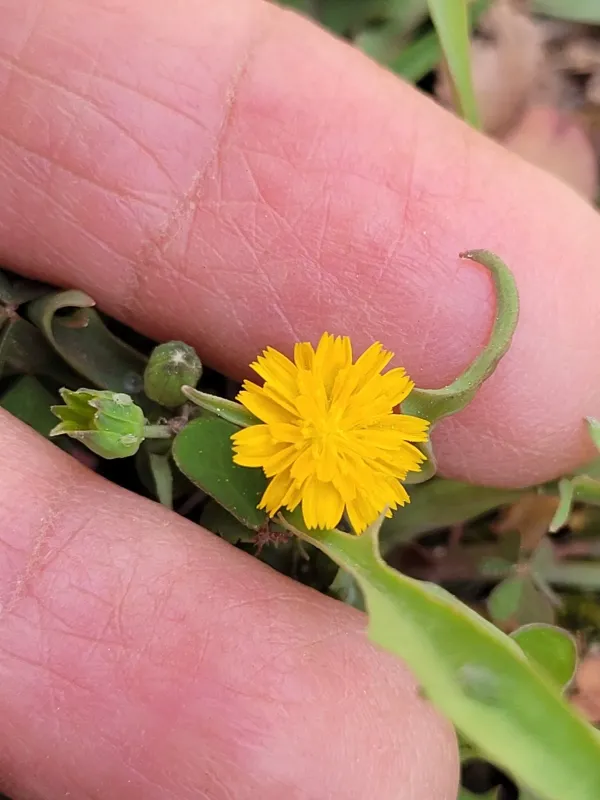
Description
How to tell it apart
Krigia cespitosa, commonly known as weedy dwarf dandelion, is an annual herb belonging to the Asteraceae family. It features a rosette of basal leaves and small yellow flower heads that resemble typical dandelions.
The plant possesses a thin taproot, enabling it to establish quickly in various soil types. Leaves are usually entire or slightly toothed, arranged in a dense cluster that provides resistance to mechanical disturbance.
Stems are typically leafless, slender, and support solitary flowering heads. The plant reaches a height of 5 to 25 centimeters, depending on environmental conditions and soil moisture levels.
The flowering period occurs during the spring and early summer, after which the plant produces achenes with a pappus, facilitating wind dispersal over large distances.
Biologically, it is classified as an early spring weed capable of infesting fields early in the growing season and competing with newly emerged crops.
Where it grows
Krigia cespitosa is native to the southeastern United States but can occur as an invasive or weedy species in various temperate climates globally.
It prefers open environments such as cultivated fields, pastures, roadsides, and disturbed areas. It thrives particularly well on moist, loamy soils.
In agricultural systems, it is most troublesome in grain crops, row-cropped fields, and fallow land, where it can quickly dominate the vegetation.
Its ability to exploit moist conditions makes it a common weed in fields where drainage is poor or where crop rotation practices are neglected.
The species exhibits high plasticity, allowing it to adapt to varying light conditions, from full sun to partial shade provided by taller crops.
Harm it causes
The primary damage caused by Krigia cespitosa involves direct competition with crops for essential nutrients, water, and sunlight, especially during the early developmental stages.
Due to its rapid spring growth, this weed can suppress crop seedlings, leading to reduced stand density and stunted growth of the main crop.
The presence of the weed complicates mechanical harvesting, as green biomass increases moisture levels in the harvested grain, necessitating additional drying and processing costs.
The weed can act as a secondary host for various pests and pathogens, which may migrate to the primary crop, thereby increasing overall phytosanitary risks.
Furthermore, heavy infestations in forage areas decrease the nutritional value of hay and reduce the overall carrying capacity of pasture lands.
How to control
Effective management begins with thorough pre-sowing soil cultivation, which destroys weed seedlings before the main crop has a chance to emerge.
Crop rotation with species that create a dense canopy is an effective cultural method to shade out the weed and limit its light access.
In grain fields, systemic herbicides can be utilized, as many Asteraceae family members are sensitive to specific chemical treatments during the rosette stage.
Inter-row cultivation in row-cropped fields is highly effective for reducing weed populations throughout the critical growing period.
- Deep plowing to prevent the germination of seeds from the soil bank.
- Implementation of crop rotation to break the weed lifecycle.
- Application of approved herbicide mixtures according to local regulations.
- Regular field scouting to identify and treat weed patches early.
Taxonomy
- Latin name
- Krigia cespitosa
- Family
- Сложноцветные (астровые)
- EPPO code
- KRICE