
Rough marshelder
Iva ciliata
Description
How to tell it apart
Rough marshelder (Iva ciliata) is an annual herbaceous weed belonging to the Asteraceae family, often recognized by its resemblance to ragweed species.
The stems are erect, branched, and can reach heights of 30 to 150 centimeters, characterized by a rough, hairy texture that is distinct to the touch.
Leaves are opposite, egg-shaped to lanceolate, with serrated margins and visible cilia (hairs) along the edges, from which the plant derives its scientific name.
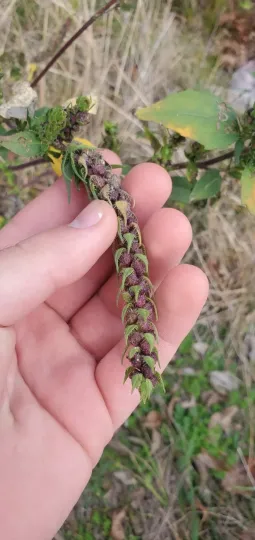
The inflorescences consist of small, greenish-yellow flower heads clustered into terminal spikes or panicles that emerge late in the growing season.
It possesses a strong, deep taproot system, providing the plant with excellent competitive ability regarding nutrient and water uptake during the summer months.
Where it grows
Native to North America, rough marshelder is commonly found in moist, fertile soils, such as floodplains, wet meadows, and disturbed agricultural sites.
In farming environments, it frequently invades soybean, corn, and grain fields, particularly those with poor drainage or where the canopy remains open for a long period.
The species is highly adaptable, flourishing in heavy soils where moisture levels remain consistent, and can easily colonize road ditches and field edges.
It is often considered a pioneer species on disturbed land, quickly covering bare soil after heavy rains or agricultural activities like plowing.
Spread is largely facilitated by water runoff during storms, as well as the movement of farm machinery that transports seeds across different fields.
Harm it causes
The primary economic impact of rough marshelder is its intense competition with crops for nitrogen, water, and sunlight, leading to significant yield suppression.
Because of its rapid growth, it can easily overtop young crop seedlings, causing them to etiolate and become weaker, which increases susceptibility to stress.
It serves as an alternative host for various pests and pathogens, potentially harboring diseases that can migrate to cash crops and lower overall plant health.
Heavy infestations create dense stands that impede air circulation within the field, creating a microclimate favorable for fungal diseases in the crop.
Harvesting efficiency is significantly reduced when this weed is present, as it complicates machine operation and contaminates the harvested grain load.
How to control
Cultural control practices, such as deep tillage, can be effective in burying the seeds deep enough to prevent emergence, although this may not be suitable for all soil types.
Crop rotation remains a key strategy, as it allows farmers to switch between crops that require different herbicide programs and cultivation timing.
Mechanical control, such as inter-row cultivation during the early stages of crop development, is highly effective at eliminating seedlings before they become established.
Chemical control involves the use of systemic herbicides applied during the early vegetative growth phase of the weed for maximum efficiency and reduction of seed banks.
- Pre-emergence herbicide applications to control early germinating weed flushes.
- Post-emergence systemic herbicides tailored to specific crop safety requirements.
- Sanitation of field borders to prevent seed production and spread into the field.
Taxonomy
- Latin name
- Iva ciliata
- Family
- Сложноцветные (астровые)
- EPPO code
- IVACI