
Iva angustifolia
Iva angustifolia
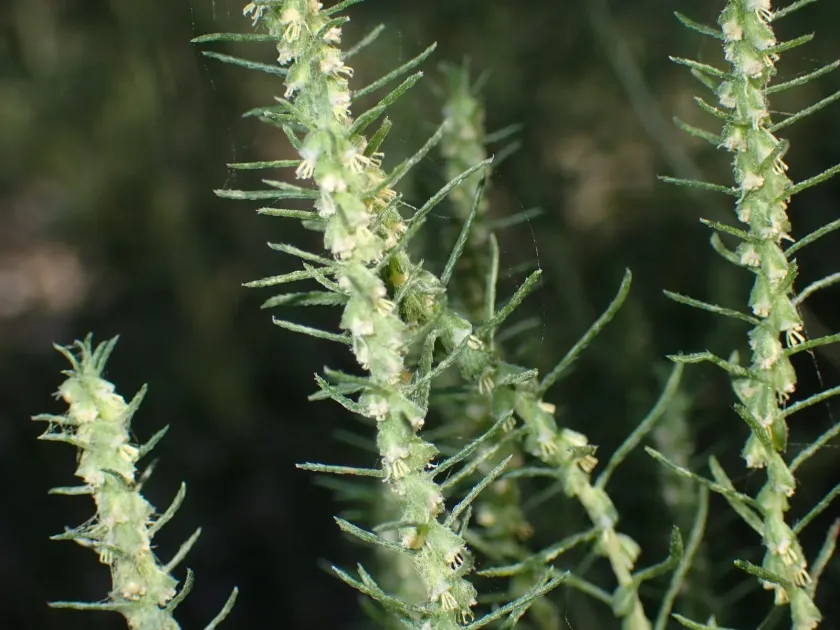
Description
How to tell it apart
Iva angustifolia is a herbaceous plant belonging to the Asteraceae family. It is recognized as a persistent weed in various agricultural landscapes.
The stems are erect, branched, and can reach heights between 30 and 80 cm. The surface of the stem is often covered with fine hairs, giving it a rough texture.
Leaves are narrow and lanceolate. They are arranged oppositely at the base and become alternate towards the top, with entire or slightly toothed margins.
The inflorescences consist of small flower heads grouped into panicles. The flowers are small, greenish-yellow, and relatively inconspicuous to the naked eye.
It possesses a strong taproot system, which allows it to thrive in arid conditions and persist even after mechanical damage to the upper part of the plant.
Where it grows
This weed is commonly found in open, sunny areas, including fallow fields, roadsides, and disturbed sites near crop lands.
It poses a significant threat to row crops, such as soybeans, sunflowers, and corn, where wide spacing provides enough room for the weed to proliferate.
Harm it causes
The primary damage is caused by intense competition for soil moisture and nutrients, which significantly reduces the growth potential of crops.
Iva angustifolia causes yield losses by shading crops during their early growth stages and releasing allelopathic substances that inhibit nearby plant development.
As a host plant, it provides a reservoir for various agricultural pests and pathogens, increasing the risk of crop infection throughout the season.
Dense infestations complicate harvesting procedures, as the plant material clogs machinery and degrades the quality of the harvested grain.
Its ability to produce large quantities of seeds ensures rapid colonization of new areas, creating long-term management challenges for farmers.
How to control
Effective management begins with deep tillage, which disturbs the taproot system and reduces the ability of the plant to regenerate from below ground.
Mechanical cultivation between rows is essential in crops like corn or sunflowers to suppress the development of weeds during the peak growing season.
Chemical control involves the use of selective herbicides applied during the early vegetative phase to ensure the weed is eliminated before it sets seed.
Implementing a diverse crop rotation is a highly recommended strategy to disrupt the life cycle of the weed and prevent its spread.
- Deep plowing.
- Inter-row cultivation.
- Herbicide applications.
- Cleaning harvesting equipment.
Taxonomy
- Latin name
- Iva angustifolia
- Family
- Сложноцветные (астровые)
- EPPO code
- IVAAG