
Isocoma veneta
Isocoma veneta
Description
How to tell it apart
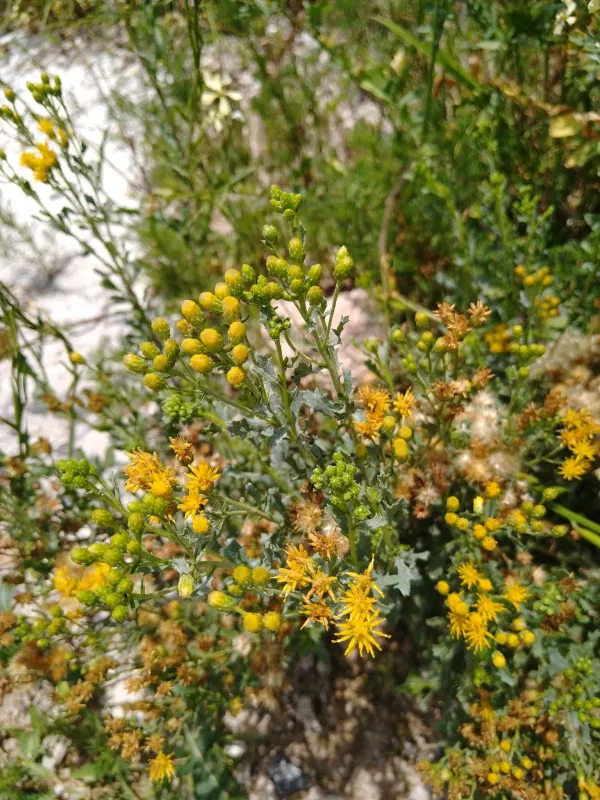
Isocoma veneta is a perennial herbaceous plant belonging to the Asteraceae family. Often described as a subshrub, it possesses a woody base that characterizes its growth pattern.
The plant typically reaches heights of 60–90 centimeters. It features erect stems with alternate, lanceolate, or linear leaves that are frequently serrated along the margins.
The inflorescence consists of numerous flower heads arranged in corymbose or paniculate clusters. These heads are composed primarily of yellow disk florets, which are the plant's most distinct feature.
It possesses a robust and deep-reaching root system that provides significant resilience in arid environments and enables the plant to survive adverse conditions.
The seeds (achenes) are equipped with a pappus, a tuft of hairs that facilitates wind dispersal across large distances, complicating the containment of this weed.
Where it grows
Isocoma veneta is predominantly found in arid and semi-arid regions, most notably in the southwestern United States and across northern parts of Mexico.
It favors open habitats, including grasslands, desert scrublands, and pastures, but is also commonly found along roadsides and abandoned agricultural fields.
In agricultural settings, this weed effectively encroaches into grain fields and forage areas, especially where crop rotation is infrequent or soil tillage is minimized.
It exhibits high tolerance for saline and alkaline soils, allowing it to successfully compete with crops in areas where other weed species struggle to thrive.
The plant thrives in disturbed ecosystems, rapidly colonizing degraded pastures where it displaces desirable native forage, negatively impacting the ecological balance.
Harm it causes
The primary agricultural impact of Isocoma veneta is its severe competition with crops for limited soil moisture and nutrients, which significantly reduces total yields.
The plant is known to contain toxic alkaloids that are harmful to livestock, particularly sheep and cattle, posing a direct threat to the safety of grazing animals.
By shading out young crop plants and absorbing fertilizers, it interferes with the uniform development of commercial grain crops, leading to qualitative losses.
The plant's efficient wind-based seed dispersal mechanism means that unchecked populations can rapidly spread to adjacent agricultural tracts.
Infestation of pastures leads to the degradation of forage quality, requiring expensive management efforts to restore the land for agricultural use.
How to control
Mechanical control involves deep tillage and plowing, which are effective in damaging the root structure and preventing the plant from re-sprouting vegetatively.
Implementing strategic crop rotations that utilize dense-canopy crops can suppress the growth of Isocoma seedlings by depriving them of essential sunlight.
Chemical control remains a critical component, focusing on systemic herbicides that penetrate the foliage and translocate into the deep root system to ensure mortality.
- Application of glyphosate-based herbicides during the active growth stage before flowering.
- Usage of 2,4-D selective herbicides for effective control in pasture environments.
- Regular mechanical mowing to deplete stored energy reserves in the roots before seed set.
An integrated weed management strategy, combining herbicide applications with consistent mechanical tillage, is essential for long-term population reduction in affected areas.
Taxonomy
- Latin name
- Isocoma veneta
- Family
- Сложноцветные (астровые)
- EPPO code
- IOCVE