
Isocoma tenuisecta
Isocoma tenuisecta
Description
How to tell it apart
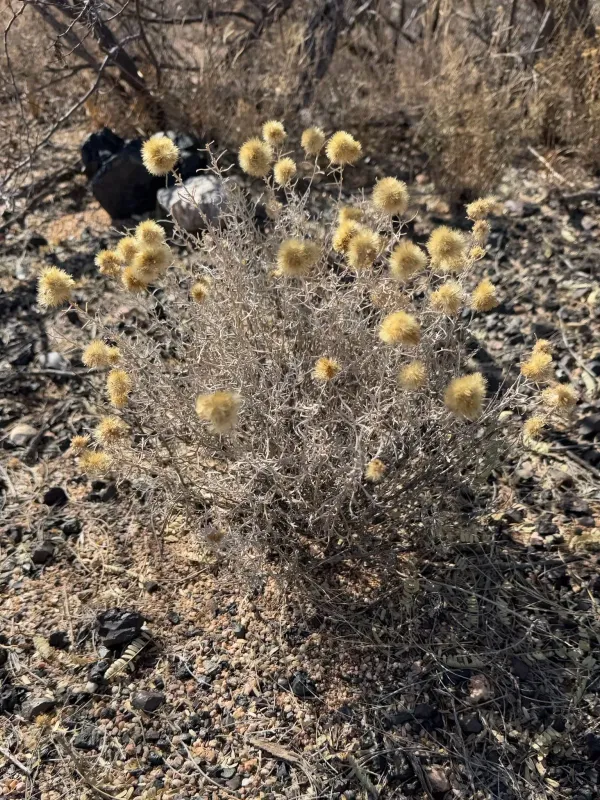
Isocoma tenuisecta, commonly known as burroweed, is a perennial subshrub belonging to the Asteraceae family. The plant is easily recognized by its upright stems and fine, deeply dissected leaves that give the plant a delicate, lacy appearance.
The plant produces numerous small, yellow flower heads clustered in dense corymbs at the tips of the stems. Flowering typically occurs from late summer through autumn, making it highly visible in arid landscapes.
Its root system is deep and expansive, allowing the plant to survive in harsh, drought-prone environments. This characteristic makes it highly resilient and difficult to eradicate once it establishes a foothold.
The base of the plant often becomes woody over time, forming thick clumps. It propagates primarily through seeds that are easily dispersed by wind, facilitating rapid colonization of disturbed soils.
Burroweed is biologically adapted to outcompete native grasses for water and nutrients, particularly in degraded ecosystems where the soil surface has been exposed.
Where it grows
Isocoma tenuisecta is native to the arid and semi-arid regions of the southwestern United States, particularly Arizona, and northern parts of Mexico.
The plant thrives in open plains, hillsides, and disturbed landscapes. It is frequently associated with overgrazed rangelands where native grass cover is minimal.
It also colonizes roadsides and abandoned agricultural lands. The presence of burroweed is a strong indicator of land degradation and excessive grazing pressure.
In its native habitat, it integrates into scrubland ecosystems, but it quickly becomes a dominant weed when the natural ecological balance is shifted by human activity.
The weed prefers well-drained soils and can withstand high temperatures and intense solar radiation, which are characteristic of its geographic distribution.
Harm it causes
The primary concern regarding burroweed is its toxicity to livestock. The plant contains certain terpenoids that can cause severe poisoning in cattle, sheep, and goats.
Poisoning incidents typically occur during periods of drought or overgrazing, when high-quality forage is scarce and animals are forced to consume the toxic foliage.
Beyond its toxicity, burroweed acts as a aggressive competitor for resources. Its ability to extract water from deep soil layers significantly reduces the productivity of native forage grasses.
The invasion of burroweed leads to a drastic decrease in the carrying capacity of pastures, resulting in significant economic losses for livestock producers.
Furthermore, dense infestations of this weed create physical barriers on the range, complicating animal movement and making pasture management more difficult.
How to control
The most effective long-term control strategy is sound rangeland management. Reducing livestock stocking rates allows native grasses to recover, which helps suppress burroweed seedlings.
Mechanical removal is viable for small patches but is labor-intensive and requires complete extraction of the root system to prevent resprouting from the root crown.
Chemical control involving systemic herbicides is widely used on large-scale infestations. These products are designed to target woody brush while minimizing damage to remaining desirable grasses.
Any control program should be implemented as part of an integrated weed management plan, considering the specific ecological conditions of the grazing site.
- Adjusting grazing intensity to support forage recovery.
- Mechanical removal or grubbing of individual plants.
- Application of selective systemic herbicides.
- Preventative monitoring to stop seed dispersal.
Taxonomy
- Latin name
- Isocoma tenuisecta
- Family
- Сложноцветные (астровые)
- EPPO code
- HAPTE