
Isocoma pluriflora
Isocoma pluriflora
Description
How to tell it apart
Isocoma pluriflora, commonly known as Jimmyweed or Rayless Goldenrod, is a perennial subshrub belonging to the Asteraceae family. It typically grows to a height of 60–90 cm and develops multiple upright, woody stems.
The leaves are alternate, linear-lanceolate, and often possess a resinous coating that gives the plant a distinct odor and protects it from excessive transpiration during hot, dry weather conditions.
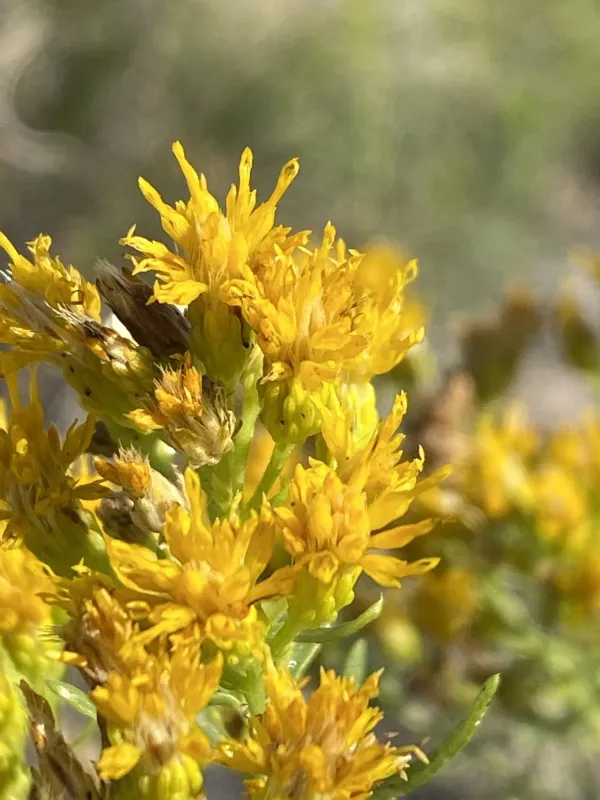
The flower heads are arranged in dense clusters at the tips of the stems. The flowers are strictly tubular and yellow, lacking the showy ray florets common in many other members of the daisy family.
The root system is characterized by a deep, sturdy taproot that anchors the plant firmly in the ground, enabling it to access moisture far below the surface in arid environments.
The seeds are equipped with a pappus, a tuft of hair-like structures that allows the wind to carry them over long distances, facilitating the rapid colonization of disturbed habitats.
Where it grows
This weed is primarily found in the southwestern United States and northern Mexico. It favors open, arid landscapes and is frequently associated with alkaline or saline soil conditions.
Jimmyweed tends to colonize overgrazed pastures and abandoned farmlands. It serves as a strong indicator of land degradation resulting from excessive livestock pressure and poor soil management.
Disturbed ground caused by erosion, drought, or overgrazing creates ideal conditions for this species to establish itself, quickly outcompeting native grasses for space and essential resources.
The plant is highly resilient and thrives where other vegetation struggles. Its ability to extract water from deep soil layers ensures its survival during severe droughts that kill off more sensitive plants.
In agricultural settings, it is often found along fence lines, irrigation ditches, and peripheral areas, which act as reservoirs for further spread into productive crop or grazing lands.
Harm it causes
The primary hazard of Isocoma pluriflora is its high toxicity. It contains a compound called tremetol, which is poisonous to cattle, sheep, horses, and other domestic livestock that consume it.
Ingestion leads to a condition known as trembles or milk sickness, which causes neurological symptoms. Because the toxin is fat-soluble, it can be passed through the milk to offspring.
The plant remains toxic even after it is cut and dried. Consequently, if Jimmyweed is inadvertently baled with hay, it poses a significant danger to livestock throughout the winter feeding period.
Beyond its chemical danger, it acts as a highly aggressive competitor for water and soil nutrients, significantly reducing the carrying capacity of pastures for productive forage species.
Financial losses stem not only from the potential loss of livestock but also from the costs associated with land reclamation, specialized weed control measures, and restricted use of infested fields.
How to control
Mechanical control involves cutting or digging out the plants before they reach the flowering stage to prevent seed set. However, this is labor-intensive and must be repeated over several seasons.
Improving the health and density of the pasture is a key preventative measure. Maintaining a vigorous stand of desirable grasses naturally suppresses Jimmyweed seedlings by limiting their access to sunlight.
Chemical control is often necessary for large infestations. Systemic herbicides, such as those containing 2,4-D or dicamba, are most effective when applied during the active growth phase.
- Use spot-spraying techniques to minimize impact on surrounding vegetation and legumes.
- Implement grazing management strategies to prevent overgrazing, which allows the weed to establish.
- Monitor field edges and irrigation channels regularly to remove plants before they spread to clean areas.
A successful management program integrates chemical intervention with consistent land management to restore the competitiveness of the forage cover, ensuring long-term control of this toxic weed.
Taxonomy
- Latin name
- Isocoma pluriflora
- Family
- Сложноцветные (астровые)
- EPPO code
- HAPHE