
Crownleaf isocoma
Isocoma coronopifolia
Description
How to tell it apart
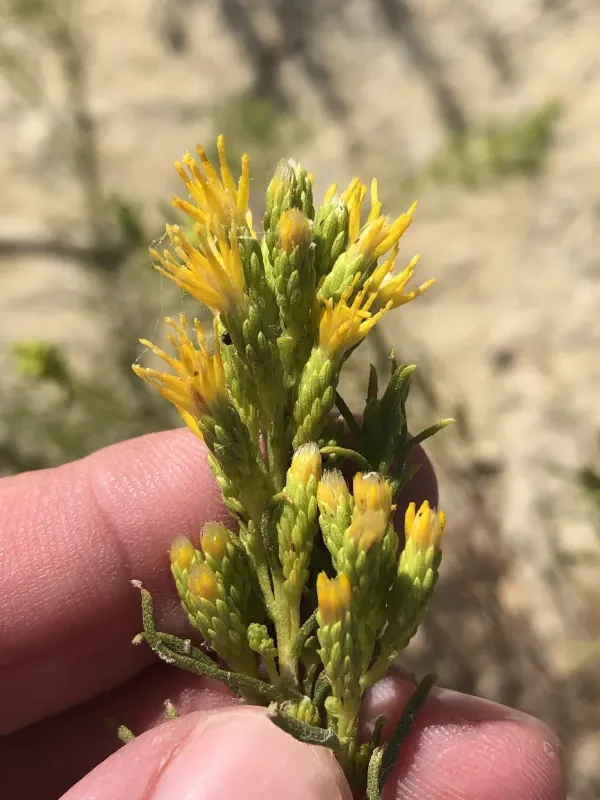
Crownleaf isocoma (Isocoma coronopifolia) is a perennial herbaceous plant belonging to the Asteraceae family. It is typically characterized as a semi-shrubby weed with rigid, branching stems.
The leaves are distinctively pinnately lobed or dentate, which gives the plant its common name and makes identification easier during the vegetative phase.
The inflorescences consist of small, dense heads arranged in corymbose clusters, bearing yellow disk flowers typical of this genus.
Its root system is particularly robust, often consisting of woody taproots or spreading rhizomes that allow it to survive in challenging environments.
The plant reproduces both through seeds, which are equipped with pappus for wind dispersal, and through vegetative propagation from its extensive root network.
Where it grows
Crownleaf isocoma is native to arid and semi-arid regions of North America, particularly prevalent in areas of the Southwestern United States and Northern Mexico.
It favors open, disturbed habitats such as rangelands, roadsides, abandoned fields, and areas with saline or sandy soil types.
In agricultural settings, it often invades field margins and irrigation ditches, slowly encroaching into active crop areas if left unchecked.
Its high tolerance for drought and heat makes it a dominant species in degraded lands where more sensitive vegetation struggles to establish.
It thrives in soils that have been disturbed by overgrazing or poor land management practices, making it an indicator of pasture health degradation.
Harm it causes
The primary agricultural impact of Crownleaf isocoma is the competition for soil moisture and nutrients, which significantly reduces crop yields in arid climates.
The plant is known to exhibit allelopathic effects, releasing chemicals into the soil that inhibit the germination and development of nearby crop plants.
It poses a significant risk to livestock; consumption of the plant can lead to toxicosis due to the accumulation of specific metabolic compounds within its tissues.
Dense infestations create physical barriers that complicate mechanical tillage, harvesting, and other standard agricultural operations, increasing operational costs.
Additionally, it serves as an alternative host for various agricultural pests, helping them survive and multiply throughout the off-season.
How to control
Mechanical control measures include deep plowing and regular cultivation, which aim to physically damage the root structure and prevent the plant from establishing a deep rhizome system.
Strategic grazing management is essential for preventing the spread of the weed in pastures by maintaining a strong, competitive cover of desirable forage grasses.
Chemical control is most effective when systemic herbicides are applied during the active growth phase, ideally before the plant enters the flowering stage.
Integrated weed management programs often combine chemical spot treatments with mechanical removal of individual plants to reduce the seed bank in the soil.
- Regular mowing to prevent seed production.
- Application of systemic herbicides during peak growth.
- Implementation of competitive crop rotations.
- Sanitation of machinery to prevent weed seed spread.
Taxonomy
- Latin name
- Isocoma coronopifolia
- Family
- Сложноцветные (астровые)
- EPPO code
- IOCCO