
Holocarpha virgata
Holocarpha virgata
Description
How to tell it apart
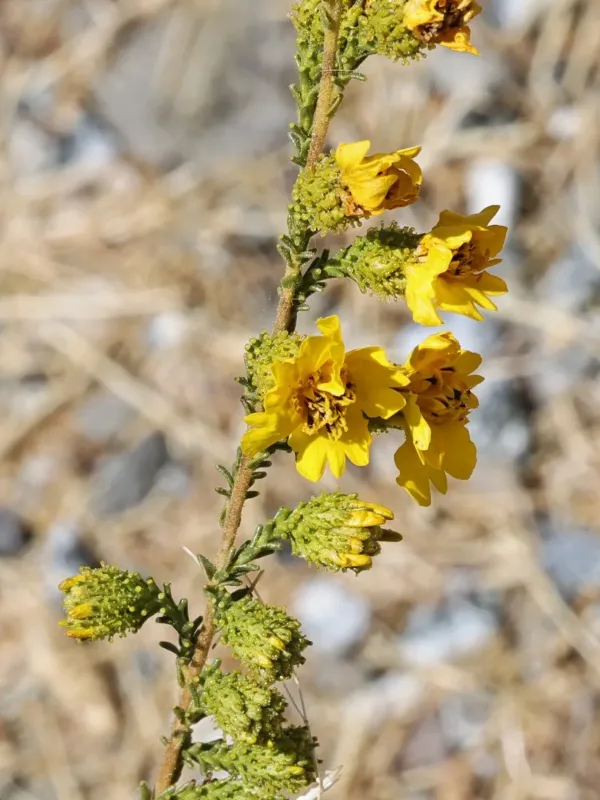
Holocarpha virgata, commonly known as common spikeweed, is an annual herb belonging to the Asteraceae family. It is easily recognized by its stiff, erect stem that branches significantly towards the top, creating a distinct, bushy appearance.
The leaves of this weed are narrow and lanceolate, densely covered with glandular hairs. These hairs exude a sticky, resinous substance, which gives the plant a characteristic tackiness and a pungent, aromatic scent when touched.
The flowering heads are composed of bright yellow ray and disk florets. Blooming typically occurs in late summer, turning fields into a mosaic of yellow as the plant reaches maturity and hardens its tissues.
The seeds are small and equipped with specialized structures for dispersal, often aided by wind or the movement of machinery. This allows the plant to colonize new areas rapidly within an agricultural setting.
A deep taproot system is a hallmark of this species, allowing it to remain vigorous and hydrated even during the peak of summer droughts when other vegetation begins to wither.
##habitat##Native to California, Holocarpha virgata is frequently found in grasslands, along roadsides, and in disturbed landscapes. It thrives in soils that range from clay-heavy to dry and gravelly, showing high ecological adaptability.
In agricultural settings, it is a significant weed in cereal fields. It exploits areas where crop canopy is thin or where soil surface integrity has been compromised, allowing for easy seedling emergence.
The plant is often found along the margins of fields, utilizing these non-cropped areas as nurseries. From there, seeds are easily transported via heavy machinery into the heart of productive cropping areas.
It prefers full sun and is rarely found in shaded environments, which makes proper crop spacing and planting density essential strategies to naturally limit the growth of this weed.
Because it is well-suited to Mediterranean-type climates, it dominates in regions with hot, dry summers, outcompeting native grasses and poorly established field crops for limited resources.
Harm it causes
The primary damage caused by Holocarpha virgata is resource competition. Its taproot penetrates deep into the soil profile, capturing moisture that is critical for crop development during the grain-filling stage.
Resinous secretions from the plant can contaminate harvested grain, affecting its quality and storage life. The sticky residues often stick to harvesting equipment, causing mechanical strain and downtime.
The presence of dense spikeweed stands significantly reduces combine efficiency. The tough, woody stems require higher power output for threshing, which increases fuel consumption and mechanical wear on equipment parts.
It acts as a host for various pathogens and insect pests that may eventually spill over into the main crop. This necessitates additional monitoring and potentially higher pesticide inputs to manage the field.
By crowding out crops, it reduces the overall yield potential. Its aggressive growth pattern can lead to significant economic losses if left unmanaged during the early to mid-growing season.
How to control
Mechanical control is effective in the early stages of development. Shallow cultivation and disking can destroy young rosettes before they establish deep taproots, preventing them from bolting.
Chemical management involves the use of systemic herbicides. Applications should be timed carefully when the plant is actively growing, usually before the onset of the flowering stage, to ensure maximum translocation of the active ingredient.
Cultural practices such as crop rotation are highly recommended. Planting competitive, fast-growing crops helps suppress the emergence of Holocarpha virgata by shading the ground effectively.
Sanitation is key to preventing the spread of the weed. Ensuring that machinery is thoroughly cleaned before moving from infested fields to clean ones significantly reduces the seed bank in the soil.
- Deep autumn plowing to bury weed seeds.
- Maintaining a dense crop canopy through proper seed rates.
- Targeted herbicide application in fallow areas.
- Mowing road edges to stop seed production.
Taxonomy
- Latin name
- Holocarpha virgata
- Family
- Сложноцветные (астровые)
- EPPO code
- HOQVI