
Heermann's tarweed
Holocarpha heermannii
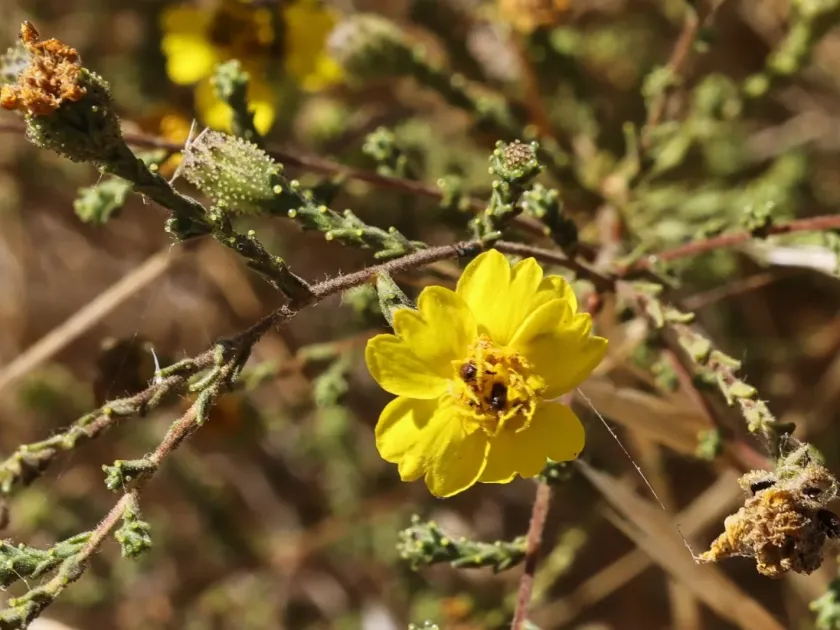
Description
How to tell it apart
Heermann's tarweed (Holocarpha heermannii) is a herbaceous annual plant belonging to the Asteraceae family. It is distinct for its sticky, glandular foliage that secretes resin.
The plant typically grows with an erect stem, reaching heights of up to one meter or more under favorable moisture conditions. The leaves are generally linear to lance-shaped.
Its yellow flower heads are prominent during the summer and autumn months. These flowers are characteristic of the tarweed genus, often featuring yellow ray and disk florets.
The root system is a deep taproot, which allows the plant to thrive in dry environments where other shallow-rooted plants might suffer during drought.
Reproduction occurs entirely via seeds. The plant produces a significant amount of seed, which can persist in the soil seed bank for several seasons.
Where it grows
This species is native to California and surrounding regions in North America. It is commonly found in grasslands, along roadsides, and in disturbed open areas.
Heermann's tarweed prefers full sun and well-drained, dry soils. It is well-adapted to the Mediterranean-style climate with long, dry summer seasons.
In agricultural settings, it frequently invades fallow fields, pastures, and poorly managed crop fields where competition from desirable vegetation is low.
The weed spreads primarily through wind-dispersed seeds, though agricultural equipment is a common vector for moving seeds between different farm sections.
Its ability to remain green and active into the late autumn allows it to occupy soil moisture resources that are vital for fall-sown crops.
Harm it causes
The primary damage caused by Heermann's tarweed is moisture depletion. Its deep roots allow it to extract water from deeper soil horizons than many shallow-rooted crops.
The dense foliage of the plant provides significant shading, which can inhibit the growth of surrounding crop plants, leading to reduced vigor and stunted development.
Its sticky resinous secretions can interfere with agricultural machinery, causing debris to accumulate on harvester components and increasing downtime.
Contamination of harvested grain with tarweed seeds can lower market quality and increase the moisture content of the crop, necessitating expensive drying processes.
Due to its competitive nature, the plant can significantly lower the overall yield of a field if infestations are not addressed during the early growth stages.
How to control
Effective management requires a combination of cultural and chemical strategies designed to exhaust the soil seed bank and prevent seed production.
Tillage practices, such as deep plowing, are highly effective at burying seeds to depths where they are unable to emerge, effectively suppressing the infestation.
Cultural methods include crop rotation and the establishment of competitive cover crops that minimize available light and space for weed growth.
Chemical control with herbicides is most successful when applied to young, actively growing plants before the development of their characteristic resinous layer.
- Mowing or grazing fallow fields to prevent seed maturation.
- Using systemic herbicides for post-emergence control.
- Thoroughly cleaning machinery to prevent seed dispersal between fields.
Taxonomy
- Latin name
- Holocarpha heermannii
- Family
- Сложноцветные (астровые)
- EPPO code
- HOQHE