
Narrowleaf hawkweed
Hieracium umbellatum
Description
How to tell it apart
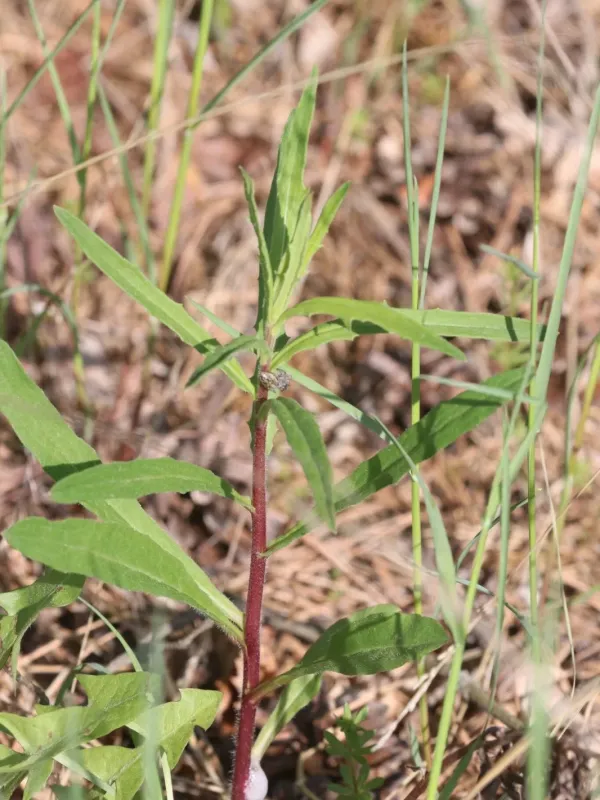
Narrowleaf hawkweed (Hieracium umbellatum) belongs to the Asteraceae family. It is a perennial herbaceous plant with an upright stem, reaching 30 to 100 cm in height.
The leaves are alternate, narrow-lanceolate or linear, often with rolled margins, which is a key diagnostic feature. The foliage may be slightly hairy or almost glabrous.
Inflorescences consist of loose corymbose or umbellate heads with bright yellow ligulate flowers. Flowering typically occurs from July through September.
The plant has a robust rhizomatous root system, which allows for aggressive vegetative propagation and regeneration after soil disturbance.
Seeds are equipped with a pappus, facilitating rapid wind dispersal over long distances, which aids in colonizing new agricultural plots.
Where it grows
This weed prefers sandy, loamy, and stony soils and is frequently found in forest clearings, meadows, along roadsides, and in fallow fields.
In agricultural systems, narrowleaf hawkweed is commonly encountered in perennial grass stands, pastures, and fields with poor crop rotation practices.
The plant exhibits high ecological plasticity, allowing it to occupy nutrient-poor and dry soils where other crop species might struggle to survive.
It often establishes on field margins and uncultivated edges, acting as a reservoir for spread into active cropping areas.
Once established in forage lands, it can form dense colonies that outcompete desirable forage species, leading to degradation of pastures.
Harm it causes
The primary damage caused by narrowleaf hawkweed is due to its high competitive ability for moisture and soil nutrients, especially under dry conditions.
Its deep root system allows it to compete effectively with crop plants for water, causing significant yield reductions in grain and fodder crops.
In pastures, its presence reduces fodder quality, as the plant contains bitter compounds and latex that make it unpalatable for livestock.
Mechanical contamination of harvest makes processing and cleaning more difficult, while potentially increasing the moisture content of the harvested crop.
The rapid production of wind-dispersed seeds leads to long-term soil seed bank infestation, requiring years of consistent management to clear.
How to control
Deep plowing is the primary agronomic method to control the plant, as it cuts the rhizomes and depletes the plant's stored energy reserves.
Implementing a rigorous crop rotation program, including dense competitive crops, can suppress the establishment of hawkweed in the field.
Chemical control involving glyphosate-based herbicides during post-harvest or on fallow land is highly effective for killing the rhizomatous root system.
For in-crop control, selective herbicides (such as 2,4-D or MCPA) may be used depending on the crop tolerance and stage of growth.
- Regular mowing of field edges and roadsides.
- Spot treatment of initial weed patches with herbicides.
- Ensuring seed purity in planting materials.
Taxonomy
- Latin name
- Hieracium umbellatum
- Family
- Сложноцветные (астровые)
- EPPO code
- HIEUM