
Woolly hawkweed
Hieracium tomentosum
Description
How to tell it apart
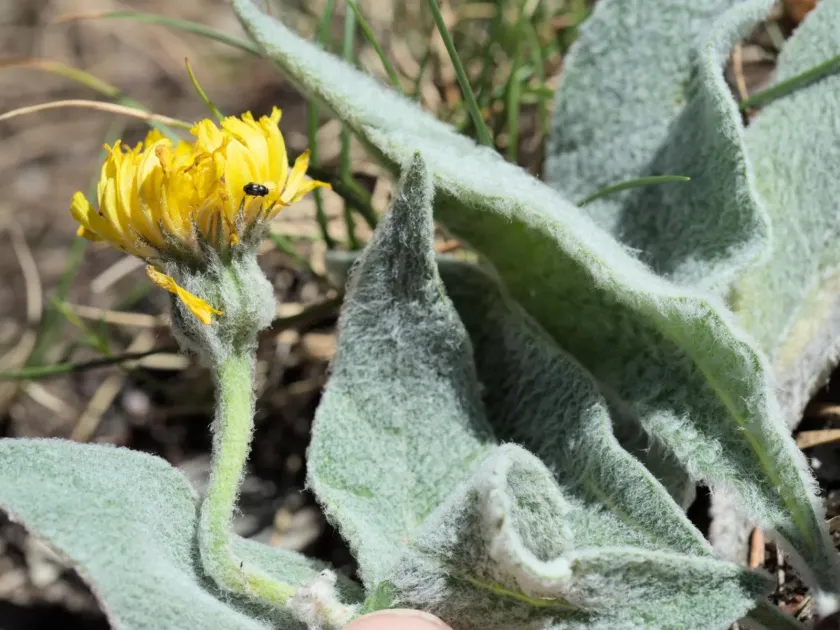
Woolly hawkweed (Hieracium tomentosum) is a perennial herbaceous plant belonging to the Asteraceae family. It is easily recognized by the dense, woolly-like pubescence covering all parts of the plant, giving it a grayish or whitish appearance.
The plant forms a basal rosette of leaves, from which a flowering stem arises. The leaves are typically elongated and covered with fine, soft hairs that help the plant retain moisture.
The inflorescence consists of yellow flower heads. The involucre of the flower head is also densely hairy, serving as a key diagnostic feature for the identification of this specific species.
The plant has a robust root system, often with perennial rhizomes, which contributes to its high resilience and ability to persist in diverse environmental conditions.
The seeds are small achenes with a pappus, allowing for efficient wind dispersal, which facilitates rapid colonization of new territories.
Where it grows
This species prefers open, sunny, and dry sites. It is commonly found in sandy soils, dry grasslands, pastures, roadsides, and abandoned fields.
In agricultural settings, woolly hawkweed often establishes itself in fields with low management intensity, especially in perennial forage crops or areas with sparse ground cover.
It is well-adapted to nutrient-poor soils, allowing it to compete effectively with crops in areas where moisture or soil fertility is limiting.
The infestation often originates from field margins or non-cultivated buffers, where the plant builds up a population before spreading into the main crop areas.
Due to its low palatability to livestock, it frequently persists in pastures that lack proper grazing management or rotational cycles.
Harm it causes
The primary damage caused by woolly hawkweed is its high competitiveness for space, moisture, and mineral nutrients, especially during the early stages of crop growth.
In perennial grass stands, woolly hawkweed can displace desirable forage species, forming dense patches that significantly reduce the overall quality and nutritional value of the hay.
Infestations complicate mechanical harvesting, as the dense rosettes and rhizome networks create physical barriers for agricultural machinery, potentially causing equipment wear.
The weed acts as a host for various pests and pathogens, potentially increasing the risk of disease spread within the agricultural ecosystem.
Control efforts involve significant economic costs, as the persistent nature of the plant requires long-term management strategies to reduce its presence to sub-economic levels.
How to control
Agrotechnical management includes deep autumn plowing to cut the root systems and prevent vegetative regeneration of the weeds.
Crop rotation is an essential practice, alternating crops that require different soil management techniques to deplete the weed's energy reserves.
Mechanical control through repeated disking of fallow fields is effective in weakening the perennial rootstock of the hawkweed.
Chemical control strategies typically rely on the use of systemic herbicides, which translocate through the plant to target the deep root system.
- Regular mowing before the flowering stage to prevent seed set and further dispersal.
- Application of selective hormone-based herbicides during the active growth phase of the weed.
- Maintaining optimal crop density to shade out young seedlings and outcompete the weed for resources.
Taxonomy
- Latin name
- Hieracium tomentosum
- Family
- Сложноцветные (астровые)
- EPPO code
- HIELN