
Savoys hawkweed
Hieracium sabaudum
Description
How to tell it apart
Savoys hawkweed (Hieracium sabaudum) is a perennial herbaceous plant belonging to the Asteraceae family, recognized as an invasive or troublesome weed in many regions.
The plant features an erect stem growing up to 100 cm in height, which is densely leafy and covered in coarse hairs, giving it a rough texture.
The leaves are lanceolate-oblong, narrowed at the base, and display serrated margins, which are distinctive botanical features for identification.
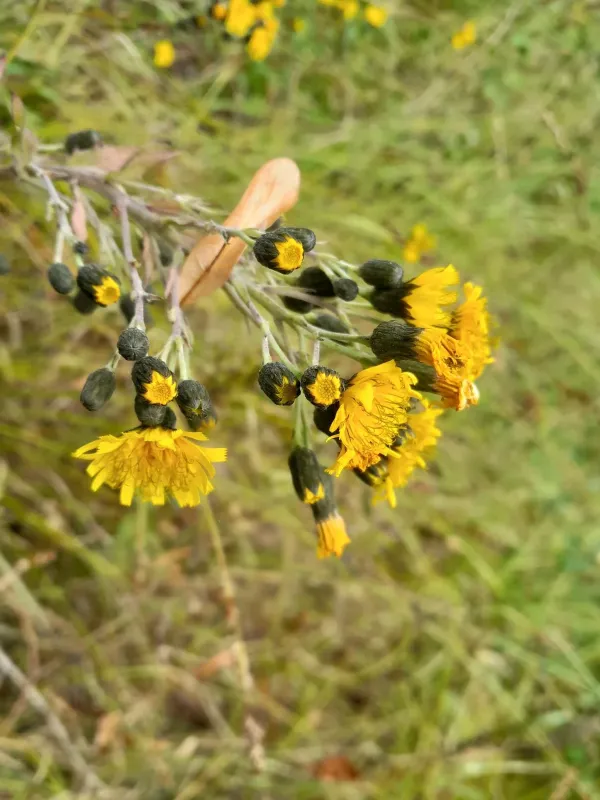
Yellow flower heads are arranged in loose corymbiform inflorescences, producing wind-dispersed seeds equipped with a pappus.
The root system is vigorous and rhizomatous, allowing the plant to spread vegetatively and survive through winter or stressful periods.
Where it grows
This species primarily inhabits forest edges, dry meadows, clearings, and shrubby areas, often found colonizing neglected land and roadsides.
In agricultural settings, it poses a threat to pastures, hayfields, and perennial legume or grass forage crops due to its ability to outcompete desired species.
It shows a preference for well-drained, moderately dry soils but possesses high ecological plasticity, allowing it to colonize disturbed ground.
While less common in intensive annual crop fields, it easily establishes along the borders and fences of agricultural lands, serving as a source for further spread.
The weed thrives in temperate climates and is highly persistent in permanent grassland ecosystems where soil disturbance is minimal.
Harm it causes
The primary damage caused by Savoys hawkweed is the depletion of soil nutrients and water, which negatively affects the yields of cultivated forage crops.
The presence of this weed in hay reduces the nutritional value and palatability of forage, as its hairy stems are often rejected by grazing livestock.
It exerts competitive pressure through allelopathic effects, releasing chemicals into the soil that inhibit the germination and growth of neighboring plant species.
Its high seed production capacity enables rapid colonization of agricultural land, leading to significant degradation of pasture biodiversity over time.
The persistent rhizomes make it difficult to eliminate, requiring repeated management efforts and causing ongoing economic loss to farmers.
How to control
Mechanical control involves deep ploughing to disrupt the rhizome network, followed by harrowing to expose and desiccate the root fragments.
Regular mowing before the flowering stage is essential to prevent seed dispersal and to gradually weaken the root system of established plants.
Chemical control can be achieved using systemic herbicides such as those containing glyphosate on non-crop areas or post-harvest stubble to eradicate deep roots.
Selective herbicides targeting broad-leaved weeds, including formulations of 2,4-D or MCPA, can be used in cereal crops to suppress populations of this hawkweed.
- Maintain vigorous crop competition through proper fertilization.
- Monitor field edges to prevent encroachment.
- Integrate grazing management to discourage weed establishment.
Taxonomy
- Latin name
- Hieracium sabaudum
- Family
- Сложноцветные (астровые)
- EPPO code
- HIESA