
Wall hawkweed
Hieracium murorum
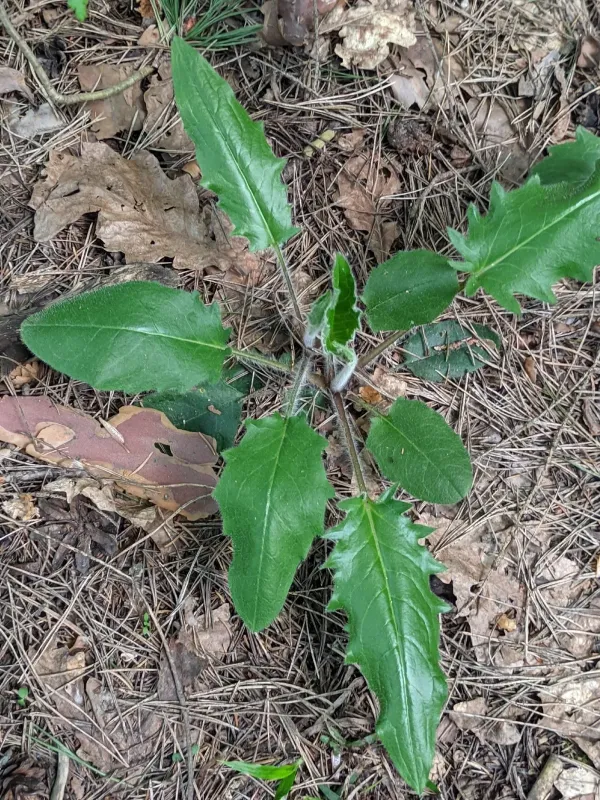
Description
How to tell it apart
Wall hawkweed (Hieracium murorum) is a perennial herbaceous plant belonging to the Asteraceae family. It is easily recognized by its basal rosette of egg-shaped leaves, which often feature irregular teeth and occasionally dark spots.
The flowering stem reaches heights of up to 60 cm and is typically sparsely hairy or glabrous. At the top, it bears loose clusters of bright yellow dandelion-like flower heads.
The plant possesses a short rhizome, allowing it to overwinter and sprout vigorously when conditions become favorable in the spring. It reproduces both vegetatively and through wind-dispersed seeds.
Botanically, it is classified as a highly adaptive weed. Its leaves often exhibit a purplish hue on the underside, providing a distinct trait for field identification against other related hawkweed species.
Its ability to thrive in varying light intensities allows it to successfully colonize diverse habitats, from sunny meadows to shaded garden edges.
Where it grows
Wall hawkweed prefers damp, shaded environments, frequently appearing along forest edges, in orchards, and on stony substrates. It is particularly adept at establishing itself in perennial grasslands.
In agricultural settings, it is often found in field margins, hedge rows, and along agricultural roads. It favors neutral to slightly acidic soil conditions.
The plant is common in areas where soil management is inconsistent, such as long-term pastures or poorly maintained orchard floors where it can compete under the canopy.
Seeds are spread primarily by wind, allowing for rapid colonization of fallow fields or areas adjacent to forest belts where the plant maintains a permanent reservoir.
Its ecological plasticity ensures it can survive harsh winters and respond quickly to early spring moisture, often emerging earlier than many cultivated crops.
Harm it causes
The primary damage caused by Wall hawkweed is its aggressive competition with crops for soil moisture and mineral nutrients, particularly during the initial phases of vegetation.
In grazing lands, this species reduces the nutritional value of forage. Cattle often avoid it due to the bitter milky sap present in the plant tissues, leading to reduced overall livestock performance.
The dense basal rosettes suppress the germination and development of desirable grasses or crops, leading to thinner plant stands and lower overall biomass production.
It can act as an alternative host for certain plant diseases, posing a risk to related crops in the Asteraceae family if population levels are left uncontrolled.
Mechanical operations, if performed incorrectly, may contribute to the vegetative spread of the rhizome pieces, complicating efforts to clear an infested field.
How to control
The most effective cultural control method is deep plowing, which effectively destroys the rhizome network and buries organic matter, preventing new growth cycles.
Regular mowing of field margins and fallow strips before the flowering stage is crucial to prevent the production of viable seeds and their subsequent dispersal.
Chemical control involving systemic herbicides is recommended for non-crop areas or as a targeted treatment in areas with high infestation rates.
For crops where herbicide use is restricted, frequent mechanical cultivation in row spaces helps to manually remove the rosettes and limit the plant's spread.
- Utilize crop rotation strategies to disrupt the weed life cycle.
- Apply selective post-emergence herbicides for broad-leaved weed control.
- Maintain sanitation at field borders to prevent seed infiltration.
- Perform field inspections to identify and remove patches before they expand.
Taxonomy
- Latin name
- Hieracium murorum
- Family
- Сложноцветные (астровые)
- EPPO code
- HIEMU