
Low hawkweed
Hieracium humile
Description
How to tell it apart
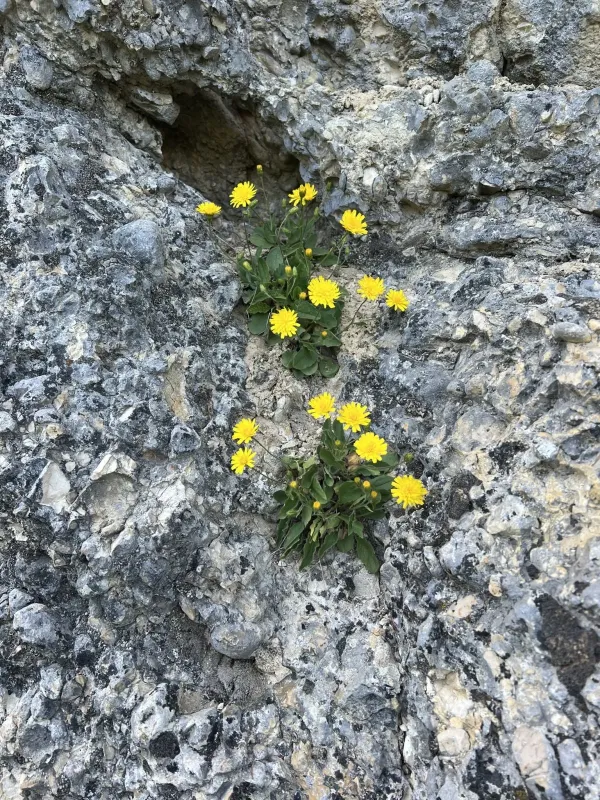
Low hawkweed (Hieracium humile) is a member of the Asteraceae family. It is a perennial herbaceous plant recognized by its distinctive rosette of basal leaves.
The plant features a central flowering stem that emerges from the rosette, bearing yellow flower heads typical of the genus.
The leaves are often covered with fine hairs, which is a common adaptive trait for this species to survive in dry or harsh environments.
Its root system is well-developed, allowing the plant to store nutrients and persist in the soil over several growing seasons.
Identification is most reliable during the flowering period, when the yellow daisy-like blooms make the plant stand out among other vegetation.
Where it grows
Low hawkweed is typically found in stony soils, rock crevices, and mountainous meadows where it competes with native grasses.
In agricultural settings, it tends to colonize pastures and marginal lands, especially where the soil structure has been compromised or overgrazed.
The plant demonstrates high adaptability to nutrient-poor soils, making it a common sight on neglected lands or long-term fallow fields.
It prefers well-lit areas and can successfully establish itself in edges of fields or clearings near forest borders.
Its presence is often a signal of degraded soil conditions or poor management practices in the crop cycle.
Harm it causes
The weed acts as a significant competitor for essential soil nutrients and water, directly limiting the yield potential of crops grown in infested areas.
In grazing fields, low hawkweed is considered undesirable as it displaces high-value forage species and reduces the nutritional value of the pasture.
The dense basal rosettes can inhibit the emergence and early growth of neighboring seedlings by blocking vital sunlight.
Due to its efficient reproductive strategies, it can quickly become invasive if not managed, leading to a decline in overall vegetation quality.
The accumulation of seeds in the soil bank creates a long-term management challenge for farmers who need to clear the land for cultivation.
How to control
Regular mowing before the flowering stage is a key cultural practice to exhaust the plant's reserves and prevent further seed dispersal.
Deep cultivation and plowing can effectively disturb the perennial root system, reducing the plant population in heavily infested fields.
Maintaining a healthy and dense crop canopy is essential to naturally suppress the germination and growth of the hawkweed seeds.
Chemical control can be achieved through the application of selective herbicides specifically designed for controlling perennial dicotyledonous weeds.
Integrated pest management (IPM) should be adopted, combining soil preparation, crop rotation, and periodic monitoring to keep the field free of the weed.
Taxonomy
- Latin name
- Hieracium humile
- Family
- Сложноцветные (астровые)
- EPPO code
- HIEHU