
Hieracium atratum
Hieracium atratum
Description
How to tell it apart
Hieracium atratum belongs to the Asteraceae family. It is a perennial herbaceous plant known for its high morphological variability, which often complicates its exact field identification.
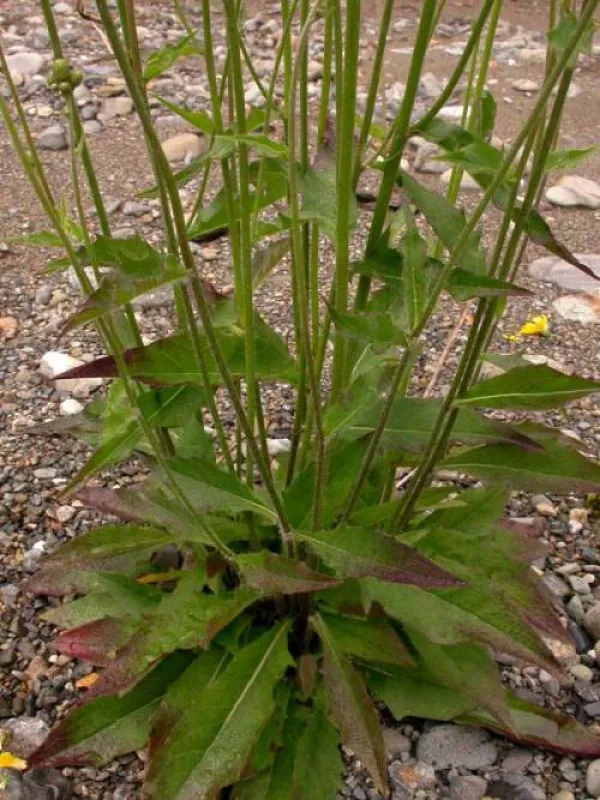
The plant typically forms a basal rosette of leaves with an upright stem reaching heights of 30–60 cm. Both the leaves and the stem are often characterized by a dense, glandular pubescence.
The inflorescences consist of yellow flower heads arranged in a loose, corymbose cluster. A distinct feature of this species is the dark, almost black, pubescence on the involucre bracts of the flower heads.
It possesses a strong, taproot system that enables the plant to efficiently secure resources, making it a competitive weed in its native and colonized habitats.
Reproduction occurs primarily through seeds, which are equipped with feathery appendages, allowing them to disperse over long distances via wind currents.
Where it grows
Hieracium atratum prefers open, moderately moist environments. It is frequently observed in subalpine meadows, rocky slopes, and along forest edges where natural vegetation is somewhat sparse.
In agricultural settings, it predominantly infests perennial pastures and meadows. It thrives in regions with cool climates where traditional deep tillage is infrequent, allowing the weed to establish deep roots.
The plant is highly frost-resistant, which enables it to persist in mountainous regions and northern latitudes where other competitive weeds might struggle to survive.
While it is less common in frequently plowed fields, it can quickly invade fallow land or neglected areas, spreading from these sources into managed agricultural plots.
It favors acidic to neutral soil types and is often found along roadsides and barren patches, which serve as corridors for further expansion into productive grasslands.
Harm it causes
The primary economic impact of this weed is the reduction of forage yield. It competes aggressively with desirable pasture grasses and legumes for moisture and soil nutrients.
When infestation levels are high, the quality of hay decreases significantly. The presence of coarse, hairy stems makes the forage less palatable to livestock, reducing overall feed intake.
The weed's ability to spread rapidly means that it can quickly replace high-value pasture species, leading to long-term degradation of land productivity if left unmanaged.
Managing the weed requires extra labor and chemical inputs, which increases the total cost of maintaining productive pastureland or preparing fields for crop rotation.
Furthermore, as a member of the Asteraceae family, it can harbor common pests and diseases that may threaten other cultivated species in the same family, such as sunflowers.
How to control
Mechanical control is highly effective; regular and deep tillage disrupts the plant's taproot system, preventing its recovery and spread in agricultural fields.
Timely mowing is a crucial practice. By cutting the plants before they reach the flowering stage, farmers can prevent the production and dispersal of wind-borne seeds.
Implementing a balanced crop rotation scheme that includes row crops helps control the weed by facilitating constant inter-row cultivation and suppressing its growth.
Chemical control options include the application of systemic herbicides. Selective broadleaf herbicides are generally effective when applied during the active growth phase before flowering.
- Conduct deep plowing before the planting season.
- Mow pastures before seeds reach maturity.
- Apply systemic herbicides for chemical suppression.
- Monitor field boundaries to prevent new colonization.
Taxonomy
- Latin name
- Hieracium atratum
- Family
- Сложноцветные (астровые)
- EPPO code
- HIEAT