
Hawkweed
Hieracium
Description
How to tell it apart
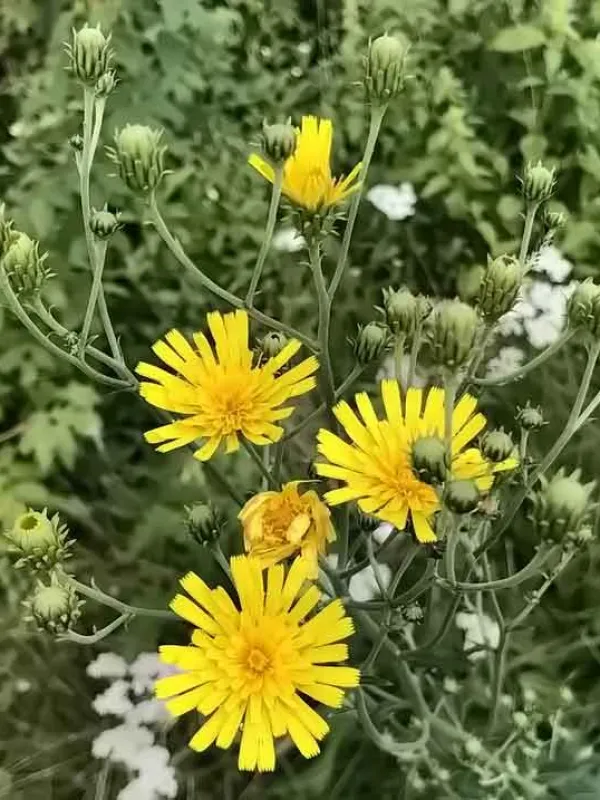
Hawkweed (Hieracium) is a large genus of perennial herbaceous plants in the Asteraceae family. These plants are characterized by basal rosettes of hairy leaves and vibrant yellow flower heads that resemble dandelions.
A key biological feature of many hawkweed species is the presence of milky sap that exudes from the stems and leaves when they are damaged or broken, providing a reliable diagnostic trait.
The root systems of hawkweed are often extensive, featuring stolons or underground runners that allow the plants to spread rapidly and form dense, persistent colonies within a field or pasture.
The seeds are small achenes with a plume of fine hairs, which enables long-distance dispersal by wind. This dispersal strategy makes hawkweed a highly effective colonizer of open or disturbed habitats.
Hawkweeds are known for their phenotypic plasticity, meaning they can adjust their growth form and reproductive strategy depending on the environmental conditions, which contributes to their status as persistent weeds.
Where it grows
Hawkweed typically thrives in nutrient-poor, acidic, and well-drained soils. It is commonly found in pastures, hay meadows, roadsides, and abandoned fields where competition from other vegetation is low.
In agricultural settings, hawkweed often invades perennial grass crops and forage lands, where its ability to outcompete desirable species can lead to a significant decline in forage quality.
The presence of hawkweed is often an indicator of poor soil fertility or acidity. It exploits these conditions efficiently, often appearing where crop growth is already stunted or sparse.
Disturbed soil surfaces and areas with minimal tillage are particularly susceptible to infestation, as hawkweed can easily establish itself in open patches left by other dying or underdeveloped plants.
While it prefers dry and open spaces, it is a versatile colonizer that can survive in various climates, ranging from lowland meadows to mountainous grassland regions.
Harm it causes
The primary harm caused by hawkweed is its competitive nature. It rapidly consumes available water and nutrients, leaving little for the crop plants, leading to reduced yields and overall stunted plant growth.
In forage and hay production, hawkweed is a major nuisance because it is often unpalatable to livestock due to its hairs and bitter compounds, which can lead to a decrease in the overall nutritional value of the harvested hay.
By forming dense, mat-like rosettes, hawkweed effectively blocks sunlight from reaching the soil surface, suppressing the germination and early development of other desirable agricultural crops.
Infestations of hawkweed can lead to the displacement of native or desirable grass species, creating a monoculture of weeds that requires extensive intervention to restore the field's productivity.
The plant also acts as a reservoir for various pests and fungal pathogens, potentially facilitating the spread of diseases within an agricultural ecosystem.
How to control
Agricultural control of hawkweed involves improving soil fertility through fertilization and liming, which creates an environment where competitive crops can thrive and crowd out the weed.
Mechanical control, such as deep plowing and regular cultivation, is effective at disrupting the root systems and destroying the rosettes before they can establish deep runners.
Chemical control utilizing selective systemic herbicides (such as 2,4-D or dicamba) is often necessary for larger infestations, particularly in permanent pastures or fallow fields.
Preventative measures, including ensuring a high-density, healthy stand of crops, are the most effective way to prevent hawkweed from gaining a foothold in the first place.
- Maintain optimal soil fertility to favor crop growth.
- Implement mechanical weed removal during the pre-flowering stage.
- Use systemic herbicides to target the root system effectively.
Taxonomy
- Latin name
- Hieracium
- Family
- Сложноцветные (астровые)
- EPPO code
- HIESS