
Bigelow's sneezeweed
Helenium bigelovii
Description
How to tell it apart
Bigelow's sneezeweed (Helenium bigelovii) is a perennial herbaceous plant belonging to the Asteraceae family, often considered a weed in moist agricultural areas.
The plant is characterized by its upright, branching stems that can grow up to one meter tall, ending in distinctive yellow flower heads.
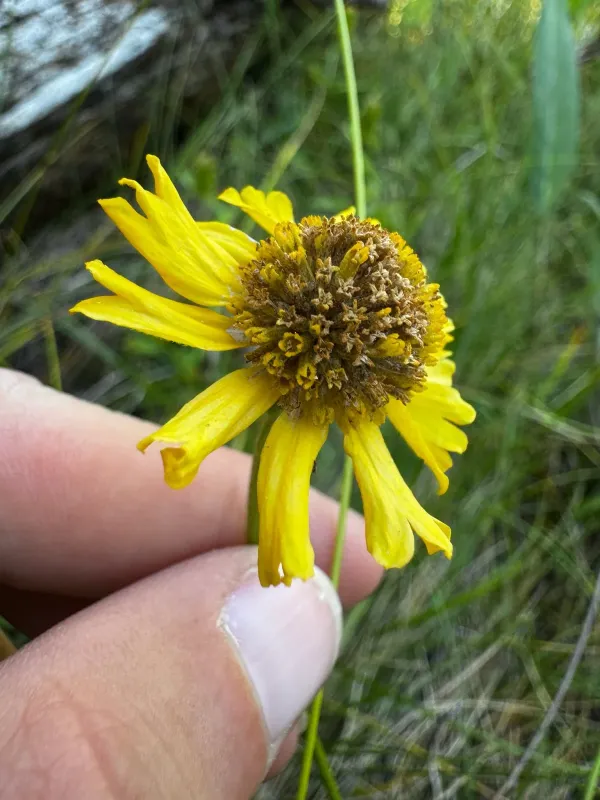
A key visual identifier is the prominent, spherical, dark brown or purple center disk, which is surrounded by ray florets that may droop slightly downwards.
The leaves are alternate, lance-shaped, and usually feature serrated edges with a light pubescence, which helps in identifying the plant in its early stages.
The root system is robust and fibrous, allowing the plant to spread effectively and return season after season, making it a difficult weed to eradicate.
Where it grows
This species naturally thrives in wet environments such as riverbanks, moist meadows, and areas with poor drainage or high water tables.
In agricultural settings, Bigelow's sneezeweed is commonly found in fields where water accumulation occurs, hindering the growth of commercial crops.
It also colonizes areas adjacent to irrigation ditches and drainage canals, utilizing these corridors to spread its seeds into surrounding cultivated land.
The plant prefers soils that remain moist throughout the growing season, which allows it to outcompete crops that may be stressed by waterlogging.
It is frequently observed in fallow lands, where it establishes permanent colonies that serve as a source for weed pressure in active cropping cycles.
Harm it causes
Bigelow's sneezeweed is highly competitive for resources, aggressively absorbing soil moisture and nutrients needed by cultivated crops to reach their potential.
The plant exhibits allelopathic properties, meaning it secretes chemical compounds into the soil that can inhibit the germination and growth of neighboring plants.
It contains toxic compounds that pose significant risks to livestock; grazing animals may suffer from poisoning if the plant is present in hay or pasture.
The presence of this weed creates obstacles for mechanical harvesting, as the stems are tough and can clog or damage farming machinery during operation.
By contaminating harvested forage or grain, the weed degrades the overall market quality and safety of the agricultural product.
How to control
Effective management begins with improving soil drainage and land leveling, as removing the moisture source is the most sustainable way to limit its growth.
Regular tillage practices, particularly deep plowing, are necessary to disrupt the root structures and prevent the establishment of deep-rooted colonies.
Mowing or hand-pulling the plants before they reach the flowering stage is essential to prevent the massive production and dispersal of wind-borne seeds.
Chemical control can be achieved through the application of broadleaf-specific herbicides, provided they are compatible with the primary crop being grown.
- Installation of subsurface drainage systems.
- Crop rotation to break weed cycles.
- Scouting and spot-spraying in perimeter areas.
Taxonomy
- Latin name
- Helenium bigelovii
- Family
- Сложноцветные (астровые)
- EPPO code
- HENBI